
Saturday, 28 March 2020
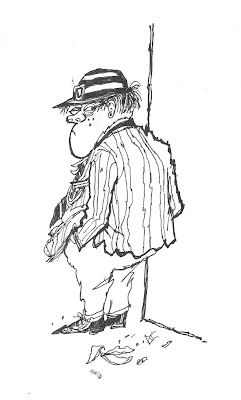
British Illustrators 6: Ronald Searle and Molesworth
In a reversal of the normal practice,
the illustrator of the ‘Molesworth’ books, Ronald Searle, is far better
remembered than the actual writer, Geoffrey Willans. Ronald Searle is best
remembered for his St. Trinians sketches, which gave rise to some successful
popular British films in the 50s, and several desperately unfunny remakes
since. Searle’s loose, anarchic style perfectly fits Geoffrey Willans’ antihero
Nigel Molesworth, schoolboy protagonist of “Down with Skool!” and three
sequels. Molesworth is a pupil at the fictional boarding school St. Custard.
Sadly I don’t think many kids still read Willans – the books are fondly
remembered and treasured by any adults of a certain age, like myself , who
discovered them for themselves, albeit they were already 20 years old when I
first read them in the 70s. Incidentally, J.K. Rowling is about the same age as
me, and I can’t help wondering if she read a lot of the same kind of books that
I did at a formative age. I say this, because Hogwarts in the Harry Potter
books is a direct lineal descendant of schools like St. Custard, Greyfriars in
Billy Bunter, Linbury Court in Anthony Buckeridge’s Jennings books, and Enid
Blyton’s Malory Towers.

Thursday, 26 March 2020
British Illustrators 5: E.H. Shepard
It’s unthinkable now that A.A.
Milne’s Winnie the Pooh books could have been illustrated by anyone else than
Ernest Shepard, yet it nearly didn’t happen. According to one source I read,
Milne originally believed that Shepard’s style was unsuitable, and only agreed
to allow him to work on the verse book “Now We Are Six”. When he saw Shepard’s
work for the book, though, he changed his mind, and indeed, once he became
convinced that Shepard’s illustration was adding to the popularity of the
books, then he voluntarily paid Shepard a percentage of his royalties.
Shepard’s most beloved work after his
Winnie the Pooh illustrations are surely his illustrations of Kenneth Grahame’s
evergreen novel “The Wind in the Willows”, and it’s one of these that I’ve
chosen to copy.

Tuesday, 24 March 2020
British Illustrators 4: Arthur Rackham and "Alice in Wonderland"
British Illustrators 4:
Arthur Rackham and “Alice in Wonderland”
Arthur Rackham, a near contemporary
of E.H. Shepard, is synonymous with a fairytale style of illustration combining
strong ink work with subtle watercolour. Rackham was the illustrator of
J.M.Barrie’s first ever Peter Pan story “Peter Pan in Kensington Gardens”. He
also made illustrations for an edition of “The Wind in the Willows”, although
I’ve chosen to copy one of his illustrations for a later edition of “Alice in
Wonderland”.

Tenniel is my hero, and for me His
illustrations ARE Alice in Wonderland, however Rackham’s style is also highly
effective at portraying the fantastic elements of Carroll’s story, even if for
me they lack a little of the sinister quality of Tenniel’s work which I like so
much.
Rackham is an illustrator whose
reputation and popularity has only increased in the decades since his death.
British Illustrators 3: Pauline Baynes and the Chronicles of Narnia
Yes, you might not have heard of
Pauline Baynes, but she was the original illustrator of C.S. Lewis’ enchanting
Narnia books. I was fortunate enough to attend a primary school in the early
1970s whose library hadn’t been updated since the 1950s. I picked up the
library’s copy of “Prince Caspian” because I liked the look of the front cover,
and from then on I was hooked. Pauline Baynes came to the attention of C.S. Lewis
through the recommendation of his good friend, and fellow Oxford don, J.R.R.
Tolkien, (no mean illustrator himself) for whom Pauline Baynes had illustrated
his highly enjoyable “Farmer Giles of Ham” tale.

I love the cleanness of her work, and
her effortless ability to conjure up epic landscapes with a few strokes of the
pen. As a kid, one of the first sketches I made that I was ever really proud of
was a copy of a Pauline Baynes illustration of a little sad dragon from “The
Voyage of the Dawn Treader”. This is a copy of an illustration from “The
Magician’s Nephew”, not the first to be written, but the first part of the
series in terms of the ongoing narrative. An utter joy.
Monday, 23 March 2020
Great British Illustrators 2: Edward Ardizzone and "The Land of Green Ginger"
Edward Ardizzone was an English
illustrator of French-Italian extraction, who illustrated a very large number
of children’s books through the 40s, 50s and 60s. “The Land of Green Ginger” by
Noel Langley, is an absolutely wonderful book, full of wit, whimsy, humour and
adventure. Although it’s called a children’s classic – which it is – it’s sadly
out of fashion now. It continues the story of Aladdin, through his son, Abu
Ali, focusing on Abu Ali’s quest to win the hand of the beautiful Silver Bud.
It’s just great, an utter gem, and I can’t wait until my grandson is old enough
for me to read it to him.

The illustration I’ve copied shows
Abu Ali and Silver Bud on the left, while his rival suitors, TinTac Ping Foo
and Rubdub Ben Thud look on from the right. Noel Langley, who wrote the novel,
was a South African writer, who wrote the original screenplay for the smash hit
film “The Wizard of Oz”, but this book, I think, is his most inspired creation,
and it’s perfectly portrayed in Ardizzone’s unique and distinctive style. It's a style which is light years removed from my own, with relatively few bold lines, and a range of shading and just suggested outliines which give his figures a shadowy, indistinct quality, almost like sfumato in its effect. If you look at this particular illustration I've tried to copy, the two foregrounded figures to the left are the two villains, Tintac Ping Foo and Rubdub Ben Thud, and I think that you can still clearly start to get an idea of these villains particular qualities.
Sunday, 22 March 2020
Great British Illustrators 1:Sir John Tenniel and Alice in Wonderland
We must all do our best to find ways to stop going stir crazy while protecting ourselves from the Covid 19 virus. One way that I've come up with is to revisit some of my favourite illustrators from books and other forms of fiction I loved as a kid. I have to start with the great Sir John Tenniel. Tenniel was the principal illustrator for Punch Magazine for over 50 years, and was the first illustrator to receive a knighthood. However for most people he is remembered for his original illustrations to Alice in Wonderland.
I grew up in my grandmother's house. She had a number of classic books which my grandfather had bought. In time I would read several of them, but was too young for all but Alice in Wonderland for a long time. This book fascinated me, and even though it was a while before I would even try to read it, Tenniel's wonderful illustrations hooked me from the start.
The first sketch here is a detail from his illustration of the Mad Hatter's tea party in "Alice in Wonderland". As I've said, for me the archetypal images of the book are from Tenniel's illustrations, the Disney film notwithstanding. Others are copies of Tenniel's illustrations for the book I made on earlier occasions (See if you can spot which one is copied from "Through the Looking Glass") :-


Last year, during my marathon stint of producing at least one sketch every day for a whole year I made a copy of a very famous Tenniel Cartoon concerning Benjamin Disraeli's purchase of shares in the Suez Canal, while he was Prime Minister.

Also, through his work for punch, John Tenniel made many images which I've recycled for my hand drawn Christmas cards for friends and families - these are just a few examples: -


 Tomorrow: Edward Ardizzone and "The Land of Green Ginger"
I grew up in my grandmother's house. She had a number of classic books which my grandfather had bought. In time I would read several of them, but was too young for all but Alice in Wonderland for a long time. This book fascinated me, and even though it was a while before I would even try to read it, Tenniel's wonderful illustrations hooked me from the start.
The first sketch here is a detail from his illustration of the Mad Hatter's tea party in "Alice in Wonderland". As I've said, for me the archetypal images of the book are from Tenniel's illustrations, the Disney film notwithstanding. Others are copies of Tenniel's illustrations for the book I made on earlier occasions (See if you can spot which one is copied from "Through the Looking Glass") :-


Also, through his work for punch, John Tenniel made many images which I've recycled for my hand drawn Christmas cards for friends and families - these are just a few examples: -


Saturday, 21 March 2020
Bakerloo Line
Bakerloo
Line – Harrow and Wealdstone to Elephant and Castle
There are 17
stations which I haven’t yet bagged on the Bakerloo. That’s a long trip,
however the Bakerloo is ideal for this undertaking for one reason. It has no
branches or arms, and is the first line which is just the one line that I’ve
encountered during the challenge. Apart from the Waterloo and City, I suppose,
but that doesn’t count because I completed that line as a consequence of doing
other lines. Of course, we need to build
a walk into the trip, and on reflection I’ve decided to walk from Kilburn Park
to Warwick Avenue, via Maida Vale. I’ll maybe say a little bit more about that
when I get there.


There’s
nothing of an Edwardian air about South
Kenton, which is hardly surprising since it wasn’t even a glint in the
architect’s eye until the 1930s. The platforms are functional then, serving
Arriva Rail London as well as the Underground, but no better than that. As for
the building, well, from the surface, well for want of a better word it’s like
a hole into a tunnel underneath a bridge. But once you get up to the platform
level ticket hall things improve considerably. This is pure art deco,
streamlined curves at both ends, with glass panels absolutely typical of the
period. If this building was out on the street, then I reckon it would have a
chance of being one of the network’s more striking stations. As it is, at least
it stands as a reward for the rather depressing walk in from the street. As for
rhyming slang, the best I could come up with was South Kenton- Sergeant Benton.
Fans of the original 1963-89 incarnation of Doctor Who will understand, and
others really shouldn’t worry about it.


Stonebridge
Park is one of a surprisingly small number of stations whose buildings were
destroyed by bombing during world war two. Or so says Wikipedia. I can only
conclude that I misread this, or it meant that parts of the station were
destroyed, since the entrance, which I sketched, is clearly an Edwardian
structure, and very unlike anything likely to have been built in 1948. I take a
closer look,
and find that the Wikipedia entry does admit that the booking hall
seems to be the original building. It’s a fair cop, guv. All in all it’s a
rather lovely little building, similar to Kenton and North Wembley, although
nicer due to where it’s sited. It’s all the more surprising considering it is
literally metres away from a depressing brick viaduct over the North Circular.
I can’t quite remember if this is the same viaduct which proclaimed M.KHAN IS
BENT in defiant graffiti for so many years in the 80s, but it might be. I
google further, and find out that no, this was much closer to Bounds Green. Ah,
nostalgia isn’t what it used to be.


There’s 6
minutes for me to wait on the platform for the next train, which is more than
enough time for the cabbie’s shelter to set me off on a train of thought. When
the Bakerloo Line was first built, horsepower literally was the most popular –
if not only – form of surface transport. That and Shanks’ pony. Alright, the
internal combustion engine had been invented, and London’s first double decker
motor buses, the estimable type B had been plying the capital’s streets for
several years. My great great grandfather wasn’t actually a cabbie, he was a
‘carman in vestry’ in Hammersmith, which I found out was the late 19th
century equivalent of a corporation dustman. Why the cabmen’s shelter brought
him to mind was that he died of pneumonia at the age of 29. So the shelters
were surely a great boon to those working the streets, even if a water trough
was all that was on offer to the poor
horses.

I already
sketched the Bakerloo Praed Street station since it’s shared with several other
lines. On the same trip I also sketched the Bakerloo Edgware Road station. So I
get what is the equivalent of a trip into hyperspace as I hop forward as far as
Marylebone Station. Hmm. Marylebone Station. Would those words have any
meaning to the vast majority of Londoners had it not been included on the
original London Monopoly Board? I rather think not. In my fifty plus years on
this planet I had never before had any cause to visit the station – and I was a
train spotter too. As a matter of fact, in all likelihood Marylebone was only
included on the board because it was an LNER terminus at the time, like Kings
Cross, Liverpool Street, and the even more obscure Fenchurch Street, which
doesn’t even have its own tube station. I’m told that this was one of the last,
if not the last mainline terminus to open in London. As a tube station, it’s
very large. As a mainline terminus it’s a little on the small side, and when
you compare it with the gothic exuberance of, say, St. Pancras and the Great
Midland Hotel, its very late Victorian gothic is rather restrained. In one way
at least I’m glad to visit, since this was where the opening scenes of the
Beatles’ best film “A Hard Days Night” were made. The Harry Potter films were
actually shot at Kings Cross though, although next door St. Pancras was used
for the exteriors. Well, there we are, that just about wraps it up for
Marylebone Station. I did not pass go and I certainly did not pick up £200.

Baker Street
is one of those stations that just keeps giving when you’ve visited it once,
and so I pass
through without getting off the train. Next stop is Regent’s Park,
and this is the last Bakerloo line station that doesn’t connect with any other
line, until we’ve crossed the river. The next – and last time it happens is at
Lambeth North, which, incidentally, is the least used station in travelcard
Zone 1, according to Wikipedia. Regent’s Park is the 2nd least used.
The ticket hall has always been subsurface. Apparently in the original act of
Parliament for the building of the line, no station was to be built here. The
ticket hall was dug beneath part of the park itself, which did cause quite
serious subsidence.
I head back
down towards the lifts, and it strikes me that I’ve been on the go for several
hours now, and haven’t got round to eating my rolls. Yet I look at the map on
the platform, and realise that although there are 5 stations between here and
Lambeth
North, I have actually visited all of them before. In fact, Lambeth
North is the only Bakerloo line station I haven’t yet bagged on this or a
previous trip. Lambeth North is a station I remember only due to its proximity
to the Imperial War

My other
memory of Lambeth North is of a joyous occasion when my O Level History class
were taken on a day trip to the Imperial Museum. We were trusted to be able to
go on the tube – a trust which proved rather misplaced. Changing to the
Bakerloo at Piccadilly Circus, Mrs. Crichton warned us all not to go running
off. So Steve Jansz and Kwinny Sanger both did exactly that, got an earlier
train than the rest of us, and were laughing their tripes off waiting for us. A
stern talking to from Mrs. C. had no effect as they did the same on the way
home. And headed off to Elephant and Castle by mistake. Mrs. C. sent the rest
of us to make our own way home, and waited to rendezvous with the others when
their train returned.
The station
itself is a little bit of what my dear old Nan would have called ‘fur coat and
no knickers.” The façade is a nice, though fairly small, 3 arch Leslie Green
job. However, if you walk round the side you soon see hat this station’s beauty
is only skin deep. I’d imagine that the buildings originally next door have
since been removed, so when you look you can clearly see where the tiling ends,
and what’s left on the side is a bare cliff of a wall unrelieved by anything
other than a large billboard.
----------------------------------------------------
There we
are, then, a whole line in a single day! I’ve come through a seriously grumpy
stretch between Willesden and Kilburn Park, and the realisation starts to dawn
on me that with two more trips I could complete the challenge. Looking back, I
think it would be difficult to make a case for the Bakerloo being one of the
most architecturally interesting lines, but I’ve generally enjoyed the trip,
and to be fair, some of the most impressive Bakerloo stations had already been
visited on earlier trips.
Here’s a
thought. With the exception of the Circle Line, which to be fair isn’t really a
line, but a service, which has no distinct stations of its own, the three lines
left are all lines which have been created in my lifetime. The Victoria Line
first opened in 1968, the Jubilee in 1979 and the Hammersmith and City gained
its independence in 1990. My plan is to go middle for diddle, taking one trip
to do the Jubilee Line next. Apart from anything else, I know that there are
some very distinctive Jubilee Line stations in Docklands built for the Jubilee
Line extension.
Subscribe to:
Comments (Atom)
Catching Up . . .
Been a while, hasn't it? Don't worry, I haven't given up sketching. No, I just haven't got round to posting anything. Now, ...

-
 Richmal Crompton was a teacher in south east London who took up writing seriously in the early 1920s after polio forced her to give up h...
 -
 Steel hulks Unregarded, unloved Waited for salvation From the gas axe, and blow torch. And saviours came. My first visit to Wales in...
 -
 Life is a like a Ferris Wheel Ups and downs And going round and round in circles. This is the biggest sketch I've done in t...