Sunday, 5 January 2020

DIstrict Line Section One: Ealing Broadway to Richmond, Wimbledon, Olympia and Edgware Road

Section One: Ealing Broadway to Richmond, Wimbledon, Olympia and Edgware Road.

I’ll tell you the thinking behind this section. Between South Kensington and Ealing Broadway there are no fewer than 4 separate branches. Now, through my previous efforts on the District Line I’d already sketched all the stations on the main branch from Ealing Common to South Kensington. So, my thoughts were that I could start at Ealing Broadway, quickly polish off Kew Gardens and Richmond, then the Wimbledon branch with its 8 stations, then walk to Olympia from Earl’s Court, and then to High Street Kensington, to get back on the train to do all stations to Edgware Road. All in all 17 stations would still be less than I’d taken in between Acton Town and Kings Cross on the Piccadilly. This would then leave me just the 30 stations from Sloane Square to Upminster, which I felt it was reasonable to expect to do in two trips. 
I’ve never felt that Ealing Broadway was a very inspiring station. When I was a kid it was entered through part of a concrete block of shops built either in the 60s or early 70s, slightly better than a hole in the ground, but not a lot. However several years ago plans were unveiled to rebuild the ticket hall as part of the Crossrail project. And let’s be fair, you wouldn’t expect the artist’s impression to make the thing look bad anyway, but all the indications are that when it’s finished it will be a considerable improvement on what was there before. However, on my visit there was not a lot to see at all. Here’s a piece of trivia about Ealing Broadway. The District Line platforms have very rare surviving examples of the original underground roundel, which has the blue band on a filled in red circle, rather than the outer band of red and inner band of white that we know and love.  
Next stop for me was Turnham Green, having already sketched all stations between on my Piccadilly Line trips. You may well be thinking – hang on, I thought you sketched Turnham Green as well. Ah yes, so I did, but Turnham Green is the closest station to Ealing Broadway from which I could catch a train on the Richmond branch. Now, I’d already sketched the first stop, Gunnersbury, and so I didn’t alight until we reached Kew Gardens. The station came as a pleasant surprise to me, looking rather like a mid Victorian national railway station. With a little research I found out that this is exactly what it is, having been originally opened by the London and South Western Railway.  
I remembered Richmond station, the end of the line, from Saturday mornings of years gone by. On Saturday mornings my brother and I, and a couple of his mates, would often take the 65 bus from Ealing Broadway to Richmond to go skating in the old ice


rink, and the bus passed the station. Of course, I didn’t notice much about the architecture back in those days. When I say that it is built in Portland stone in an art deco style, you may well be picturing in your mind the work of Charles Holden, yet this is something quite different. This station was designed by James Robb Scott, who was the chief architect of the Southern Railway, who ran the national rail services through the station at the time at which it was built. I like it. It’s an interesting interchange as well since the station also serves the London Overground, and National Rail as well.

Now, I could have taken the train back up the line all the way to Earl’s Court, where I could switch to the Wimbledon Branch. However I really wanted to avoid retracing my own steps as much as possible. So, being as we were already south of the river, I had plotted out a route involving taking the 493 bus to Wimbledon. The journey of just less than an hour wouldn’t be as quick as using the underground, but on paper there was only about 10 minutes in it, and it had the bonus of making me feel as if I was continually making progress, rather than retreating back the way I’d come.  
Like Richmond, the main entrance to Wimbledon Station was constructed by the Southern Railway, although this one is a few years earlier. Unlike Richmond, though, there’s a lot of shiny chrome and brightly coloured plastic beneath the awning, and it all gives the station a far more modern feel than you’d maybe expect from a station that is over 9 decades old. Wimbledon doesn’t connect with the London Overground, but it does connect with National Rail, it will be on Crossrail, and even better, it has a tramstop! I had seriously considered not doing the Edgware Road line on this trip, so that I could ride the tram – I’m sorry but I absolutely love trams as well as metros – and take in a couple of relatively nearby Northern Line stations. But no, a challenge had been set. It may have been a pointless challenge, but that didn’t mean that I wasn’t going to take it seriously. Ish.  
The next stop, Wimbledon Park, came as a bit of a surprise. I’m not entirely sure what I expected, but it wasn’t what I found as I emerged from the station. It’s rather an odd looking place. It’s somehow too small to be impressive as a station, yet it’s too big to be a Victorian House, which it rather resembles, albeit that the roof is rather too steeply pointed. I wouldn’t be the least bit surprised if this one has been here since the line opened in 1889. All in all it’s somehow not quite as pretty as it maybe should be. The two chimney pillars on either side are unnecessarily blocky, and the newsagents which occupies most of the building’s frontage doesn’t do it many favours in my opinion. Nonetheless, variety is the spice of life, and this station is certainly different from most of what we’ve seen before.

I guess this is why Southfields station looked familiar, being another survivor from the opening of the line in 1889. In many ways it looks quite similar to Wimbledon Park – same too steep roof, same ugly chimney pillars. However, as you probably already know, Southfields is the closest station to the All England Lawn Tennis and Croquet Club – Wimbledon, and so it was quite extensively upgraded for the 2012 Olympics, where Andy Murray would win gold in the men’s singles and silver in the mixed doubles. No prizes for guessing which two weeks every year see the station at its busiest.


Like the two preceding stations, East Putney looks as if it may well be the original station building from the late 19th century. Yet there’s quite a different design ethic going on with this station. There’s no pointed roof for one thing, instead a pleasing shallow pointed gable in the centre of the facade. The large hemisphere windows above the widows either side of the doorway, and above the doorway itself are a little reminiscent of Earls Court and Baron’s Court, and all in all this is just a very pleasant little station. And that’s us done south of the river with the District Line. 6 stations in all . Mind you, there’s less than 30 stations south of the river as it is, and that’s counting the DLR too. Stlll, while we’re talking about the river, the District Line is the only one to cross it on bridges.
Speaking of bridges, the next station is actually Putney Bridge. It’s another venerable building, as seems very much to be the case on this particular branch of the District. The station originally opened in 1880, and is literally just around the corner from the bridge from which it takes its name. This is a rather impressive building, especially when compared with the self-contained cosiness of East Putney, with which it shares a shallow gable above the entrance, and not much else. On a point of pedantry, the name of the station is a little misleading since it isn’t in Putney as such, being on the north side of the river and therefore in Fulham.  
Like Cockfosters on the Piccadilly, Parsons Green is one of those places that I have only ever heard of from the tube map. I don’t recall anybody either telling me that they came from Parsons Green, or that they had to go to Parsons’ Green. Still, in its favour the station building is the original, built by Mr. Clemence (Ray? Surely not?) under the supervision of John Wolfe Barry. Wolfe-Barry’s most impressive contribution to London is probably Tower Bridge. You can see it was built in the same era as the previous two stations, although this is a rather more modest affair, interestingly tacked onto the side of a viaduct.


So, just when I was really starting to expect all of the stations on the Wimbledon branch of the District Line to be Victorian relics, I arrived at Fulham Broadway. You may remember how the Hammersmith station serving the Piccadilly and District Lines is entered through a 90s shopping mall? Well, in the noughties the old station building was closed, and entry has to be made through the Fulham Broadway Shopping Centre. Like most people of a certain age, my main memory of the station prior to visiting it on this trip was from Ian Dury and the Blockheads’ single ‘What A Waste’ where the lyric goes – “I could be the ticket man at Fulham Broadway Station.” To be fair, all I saw when I visited were automated barriers, but there you go.


So to the last stop on the branch – or the first if you’re coming from the other direction – West Brompton, and after the shock of the new at Fulham Broadway we’re back to the Victorian ethic of East Putney and Putney Bridge. I’m quite glad about this, since I’d made up my mind to do a second walked section. I’d worked out that I could pretty much follow the rail route to Olympia via Earl’s Court on foot, and then get back on the train at High Street Kensington. This would mean that I could avoid the hassle of changing trains, and hanging around at Olympia. By my reckoning I could get to High Street Kensington if I got a bit of a wiggle on. Then that would just leave the 4 other stations ending in Edgware Road, and my marathon day mopping up the western branches of the line would be complete, without me having to double back along any of the lines. 
Olympia is only open at weekends, and for special exhibitions. Frankly, it isn’t much to write home about. I get the feeling that it’s far more important as a national rail station than as a tube station, and as a result the buildings are 1980s-era British Rail crap. They’re the sort of thing you buy at the end of a shopping expedition when you’re patience has been exhausted, and you’ll buy any old rubbish just to bring the ordeal to an end. I had a university friend who lived in a flat just around the corner, which come to think of it was a hell of a commute for her considering that we were attending Goldsmith’s College in New Cross, still, it was memories of this time in my life which reminded me that it wasn’t all that far to High Street Kensington.
I had a feeling, a half memory, that the station at High Street Kensington was similar to the Piccadilly Line station at Knightsbridge. I suppose that it is in as much as it’s built into a parade of very large shop buildings. But at least there’s a sense of style about it. The large hemispherical window , ad Portland stone pilasters either side of the entrance at least give it some atmosphere, and mark it out that this is something quite different from the commercial premises on either side. The Kensington Arcade, which contains the actual entrance to the station, has a real elegance and airiness about it as well, so coming after the disappointing station at Olympia this was something of a pleasant surprise.


Well, there I was, over 70 stations into the challenge, and Notting Hill Gate provided only the 3rd hole in the ground so far, after Hyde Park Corner and Piccadilly Circus. The current, subsurface station opened in 1959. The rebuilding during the 50s, which saw street level station buildings removed, making way for a subsurface ticket hall which could be jointly used by both District and Circle lines, and also the Central line. The Central and District Lines do diverge at this point, but not by much. Next stop on the Central line is Queensway, and it is actually a very short walk from Queensway on the central line to Bayswater on the District. I know that because I often used to go ice skating in Queens, and you can clearly see one station from the other. As a matter of fact I met the future Mrs. Clark therein 1985, but that’s another story.


Bayswater itself is a rather attractive station, quite possibly the original building, although it’s one of those which probably isn’t best served by the blue canopy proclaiming the name of the station over the entrance. What with the ornamented balustrade, this looks similar in style to the District Railway style of Barons Court, and that's enough to make it a very pleasant surprise.


Nearing the end of the marathon trip, it wasn’t until I exited from Paddington’s impressive former Metropolitan Railway façade on Praed Street, I realised that Paddington is, in fact, 2 Underground stations – or rather there are two underground stations called Paddington, and what’s more the same can be said of Edgware Road, just along the line. I suppose that I can be forgiven for forgetting about this by the fact that the tube map does show them as a separate station, which they are not. The two stations form a fascinating contrast. The District Line uses the Praed Street Station, which proclaims its Metropolitan Railway origin proudly, and may date back as far as 1868. However the Hammersmith and City Line station, which originally opened in 1863 as the Western Terminus of the Metropolitan Railway has a very modern entranceway, which looks to be in a very similar style to the stations on the Jubilee line extension. We’ll get to them when we eventually mop up the Jubilee. At one time the two stations were distinguished by having Praed Street and Bishops Road appended to their names, but not now. 
I can, sort of, understand there being two underground stations at Paddington, what with the importance of the main line railway terminus. But Edgware Road? It beggars belief that there are the two separate stations only 150 yards or so apart , and separated by the Marylebone Road. The District, Circle and Hammersmith and City station was there first, being part of the original Metropolitan Railway 1863 line. Confusingly though, it looks more modern. The station was extensively remodelled in the 1920s, and it’s difficult to know just by looking at it how much of the Victorian original remains. I’d guess that
the frieze which declares that it is the Metropolitan Railway may well be original, but I can’t be certain. The Bakerloo Line station, though, is much easier to date, bearing the familiar Leslie Green hallmarks of ox blood tiles, and hemi-spherical windows. Apparently there have been moves and attempts to rename one of the two stations to end the confusion between the two.


In terms of stations visited, this trip saw me visiting fewer than I’d visited between Chiswick Park and Kings Cross. However it felt like more, and was a more exhausting trip. Maybe it was because the trip saw me visiting 5 ends of the District Line, and in my experience you can often end up waiting longer for your train to depart when you’re at the end of the line. Maybe it was crossing the river twice. Whatever the case, this was the first real time on the challenge when I felt I could honestly say that I didn’t want to think about another tube station for a while. Which was a bit of a pain considering the journey back which lay ahead of me.

Wednesday, 1 January 2020

Piccadilly Line - Section 4 : Caledonian Road to Cockfosters


I entered on this final Piccadilly Line trip with a sense of mounting excitement. I knew that some of the finest stations on the Piccadilly Line lay ahead – and therefore some of the finest on the whole network. Also, I’d seen the name Cockfosters as a destination so many times as a kid, yet had never been there. What was it like? I would find out by the end of the day. 

I’d already decided what my walked section was going to be. After my mother married my stepfather in 1996, they lived in Tottenham for 15 years, and because of many visits I knew the overground way between Turnpike Lane and Bounds Green via Wood Green station pretty well.  

Next stop on from King’s Cross, then, is Caledonian Road. I was tempted to walk this section so that I could check out the disused Leslie Green York Road station. It closed the same day that the Piccadilly Line extension to Finsbury Park opened in 1932.The buildings survived, I guess, because they were used as commercial premises for some time, and survived World War II. At the moment the station stands as an emergency exit from the tunnels. As I say, I was tempted to walk between Kings Cross ad Caledonian Road to take in York Road, but the fact is that I know this section of the Piccadilly Lie less well than the others, and although I only had 12 stations to visit, I had no idea how long this section was going to take me, and so I erred on the side of caution. Caledonian Road is a larger Leslie Green station, rather reminiscent of the station at Russell Square.  

The next station, Holloway Road, is also a larger Leslie Green station – this one has 6 semi circular windows on the façade as opposed to Caledonian Road’s 5. When you look at these stations you can see that they are pretty substantial buildings in their own way, and so you can understand how people think that overwork contributed to Leslie Green’s tragic early death from TB. Holloway Road station’s claim to fame is that it once housed a spiral escalator. A spiral escalator which didn’t work, and was apparently never opened to the public. The opening of this station put paid pretty much to the Great Northern Railway’s Caledonian Road and Holloway station which was originally opened in the 1850s, but closed within a few years of the current station opening.  

I’ve been a Spurs supporter since the 70s, and I do know fellow Spurs supporters who call the next station Gillespie Road. To be fair this is the name which is still spelled out on the wall tiles on the Piccadilly Line platforms. It was only called Gillespie Road from opening in 1906 for the next 26 years, after which it was named Arsenal (Highbury). I could write a lot about the enmity between the two North London clubs, but you’ll be pleased to know that I won’t. But let’s pay tribute to Arsenal’s legendary manager from the 30s, Herbert Chapman, whose lobbying probably tipped the scales for the renaming of the station. The name remains, even if Arsenal didn’t, their current home, the Emirates Stadium, being closer to Holloway Road. The original Leslie Green building went the way of all flesh in the 30s, and the current building was built. It’s definitely a modernist style, but if it was designed by Holden, I guess it may have been a Friday afternoon design. It’s blocky and uninspiring, and would really have benefitted from one of his trademark glass screens.  

Finsbury Park is the last station on this northwards section of the Piccadilly Line to connect with any other line, in this case the Victoria Line, and national rail services, and to be fair it was originally opened in the 1860s on the Great Northern Railway line into their Kings Cross terminus. Originally, Finsbury Park was the northeast terminus of the Great Northern, Piccadilly and Brompton Railway. The Western Entrance, shown in the sketch, is actually the newest thing on any Piccadilly Line station at the time of writing, since it only opened in December 2019.


The Piccadilly Line boasts three stations with the word ‘Manor’ in their name. Boston and Ruislip are on the two western arms and we visited them The third and final on the Piccadilly is Manor House. Now, I’ve tried to be positive about the vast majority of the buildings I’ve sketched along the way, but, I have to say that calling this station Manor House is just writing a cheque which the building itself can in no way, shape or form cash. If Arsenal looks like it was designed on a Friday night, then this one looks like it was designed when he got up hungover on a Sunday morning and just couldn’t be arsed. Sorry. At least it’s brick faced, and has some windows, but, to be honest, it looks like he’s forgotten the rectangular ticket hall which transforms so many of the stations on this line. Time to move on.  


Thankfully, Holden returned to form with the run of stations from here to the end of the line. We start with the next station, Turnpike Lane. Now, here’s a funny thing. Driving to my Mum’s old house in Tottenham from the west, the best way was always to go along the North Circular, and then turn off for Wood Green. In the process you’d pass Bounds Green, then Wood Green, and if you carried on rather than turning up Lordship Lane, then you’d come to Turnpike Lane. Which is actually the opposite order from that in which the train passes through them. Go figure. In some ways this is almost a Holden Greatest hits compilation. Tower? Check. Rectangular booking hall with glazed sections? Check. Long low wide entrance? Check? Semi Circular ends? Of course.


A short walk slightly uphill to Wood Green took me past what I know as the Shopping City complex, but which now calls itself the Mall Wood Green. Call it what you like, its 70s architecture is uninspiring, but at least it was built after the UK’s civic architects rediscovered brick. Had it have been built a few years earlier no doubt it would have presented a dirty grey concrete face to the world.  

I mentioned the junction with Lordship Lane a little earlier, and once I’d crossed that busy intersection I had arrived at Wood Green station. We can be thankful for small mercies here, since if the station had been sited just the other side of the Lordship Lane junction, then it’s not impossible it would have been rebuilt as part of the shopping city complex. As it is, though, we still get to enjoy Charles Holden’s curved frontage, with its ventilation towers. Apparently the towers were later additions, according to my research.

 Bounds Green stations is one I had only ever undertaken on a train, or in a car. Underground, the road gradient makes no difference, and it doesn’t make much more in a car. On foot, though. . . well we’re not exactly talking Hovis advert gradient, but the uphill drag went on and on, and I have to say that I’d had quite enough of the Bounds Green Road by the time I reached the station of the same name. The station houses a plaque which stands as a memorial to people who were killed when the station tunnel, in which they were sheltering, collapsed during a bombing raid during world war II. Up until this trip I’d never been past Wood Green on the Piccadilly Line so far, so I have to say that I was particularly looking forward to getting back on a train at this point. I have to say that I have a real soft spot for this station. It’s beautifully proportioned, and pleasing to the eye, yet it rarely receives the plaudits so often bestowed upon our next station.
Between the wars, Charles Holden and Frank Pick made a trip to Europe to check out modernist ideas in architecture in a number of countries. The story goes that Holden’s design for Arnos Grove station was inspired by Stockholm’s Public Library. Well, I was in Stockholm in February 2019 and I did see Gunnar Asplund’s famous building, but I have to say that it doesn’t strike me as being much more than a general resemblance, that is, a circular central hall on top of a rectangular building. The station is, of course, much smaller in size and scale, but in my chauvinistic Londoner’s opinion, rather more graceful and appealing. We hadn’t seen a circular ticket hall since Chiswick Park in the previous marathon section. This station was the original terminus of the Piccadilly Line extension, and as a terminus it does have more of a sense of occasion than Cockfosters, which replaced it as the terminus a ear or so later. People often hold up the stations on this section of the Piccadilly Line as examples of the genius of Charles Holden, and when you see stations like Bounds Green, this one and Southgate in succession, you can understand why.


So I’ve already bigged up Southgate station, and that is with the benefit of hindsight. I would imagine that my first reaction to the station when I walked out of it was pretty similar to most people’s, that is that it looks as if a flying saucer from a 1950s B movie has landed in suburban North London. I absolutely love this station. I can only imagine what the reaction of people was when it first opened in 1933. It must have been like walking onto the set of Metropolis, or the Flash Gordon movie serials. I make the connection to movies of the time deliberately, since I’m convinced that movies I part influenced Holden in his design. The story goes that the structure on the roof was inspired by the tesla coils which help bring the monster to life in the 1931 movie “Frankenstein”. This station is about as far as you can get from Holden’s own appraisal of his stations as ‘brick boxes with concrete lids’.  

I didn’t previously know that the line emerges overground before Oakwood, so at least I’ve learned something on the trip. On emerging from the building my first thought was that I’d somehow gone through a wormhole back to Acton Town, since, superficially at least, the stations seemed very similar. A quick walk around showed me a rather fetching station sign combined with a seat which I’m guessing were original art deco features of the station.  

That was it, the penultimate station of the Piccadilly Line, which only left the enigmatic Cockfosters to go. I say enigmatic for a couple of reasons. Firstly, in all the time I lived in London, I don’t recall anybody ever announcing that they had to go to Cockfosters, or ever mentioning it in conversation. I had absolutely no idea what Cockfosters was actually like as a place, nor why the Piccadilly Line should choose to end there. As for what the station actually meant. .  . Well, that I’ve since discovered is simple – it’s on Cockfosters Road. Foster is a shortened version of the word forester, and the cock forester was the head or chief forester. Quite prosaic when you know, isn’t it? The station itself is another of those unassuming Holden jobs, although the small towers at either end, and the original glass screens do provide just enough to divert the eye and give it a pleasing if unspectacular appearance.  

--------------------------------------------------------------------- 

That was it. I had half a mind to go for a walk around the local area to try to get a feel, but to be honest I was just too tired. What can I say – it looked like the outskirts of London, which is exactly what it was. During the long ride back to Boston Manor I tried to assemble my thoughts, now that I’d visited every station on the line, and sketched all bar the 12 on this trip, to draw some sort of conclusion about the Piccadilly as a whole. You can certainly draw comparisons between the three ends of the line, since two of them were entirely built in the 1930s, and all bar Hatton Cross and the Heathrow stations on the other was bult at the same time. Yet even on these sections there are not only newer rebuilt stations as you might expect, but there are also older remnants, like Hounslow central, Ruislip and North Ealing. This hodgepodge is even more noticeable in the Central London sections where the Harry Fords mingle with Leslie Greens, a couple of token Holdens, and some holes in the ground. I did wonder whether this was how it was going to be for the remaining lines. 

Speaking of which, I had to think about which line I should do next. The Piccadilly has the second highest number of stations, after the District Line. That was a strong argument for doing the District next, as was the fact that I’d already sketched quite a number of the more westerly District Line stations. Also, the westernmost terminus of the line was none other than my ‘third’ home station, Ealing Broadway. District Line it was, then.

Saturday, 28 December 2019

Section 3 Acton Town to Kings Cross


Additional Rule – Rule 5


In the walked parts of each section, whenever a station on another line is nearby it is permissible to include them on the same trip. 

Now, there are 4 District Line stations between Acton Town and Hammersmith. I can distinctly remember the Piccadilly Line stopping at all of them, however that’s not the case now. So as not to cut off my nose to spite my face, I decided to do all of these stations as part of this section. What’s more, it seemed like a good idea to use this as my walked section.

So, a brisk walk from Acton Town to the North Circular, and then back to the junction with Chiswick High Road. Incidentally, this took me past Gunnersbury station. Gunnersbury is on the District line branch out to Richmond. The area is known as Gunnersbury since King Canute gave it to his daughter Gunnhild in the 1000s, hence it became known as Gunnhilds Burg, or Gunnhild’s Mansion. Frankly, I had no wish to linger around the station once I’d taken my requisite photographs. The entrance is through this undistinguished portal into a rather nasty 1960s block. Nothing remains to suggest that the station was actually damaged in the London tornado of 1954. Still, if nothing else, at least Gunnersbury was the 27th active station of my challenge. What’s the significance of that, you might ask? Well, bear I mind that there are currently 270 stations, this meant that I’d actually visited 10% of them already. I tried to push the thought that there were still 90% of them to go out of my mind. 

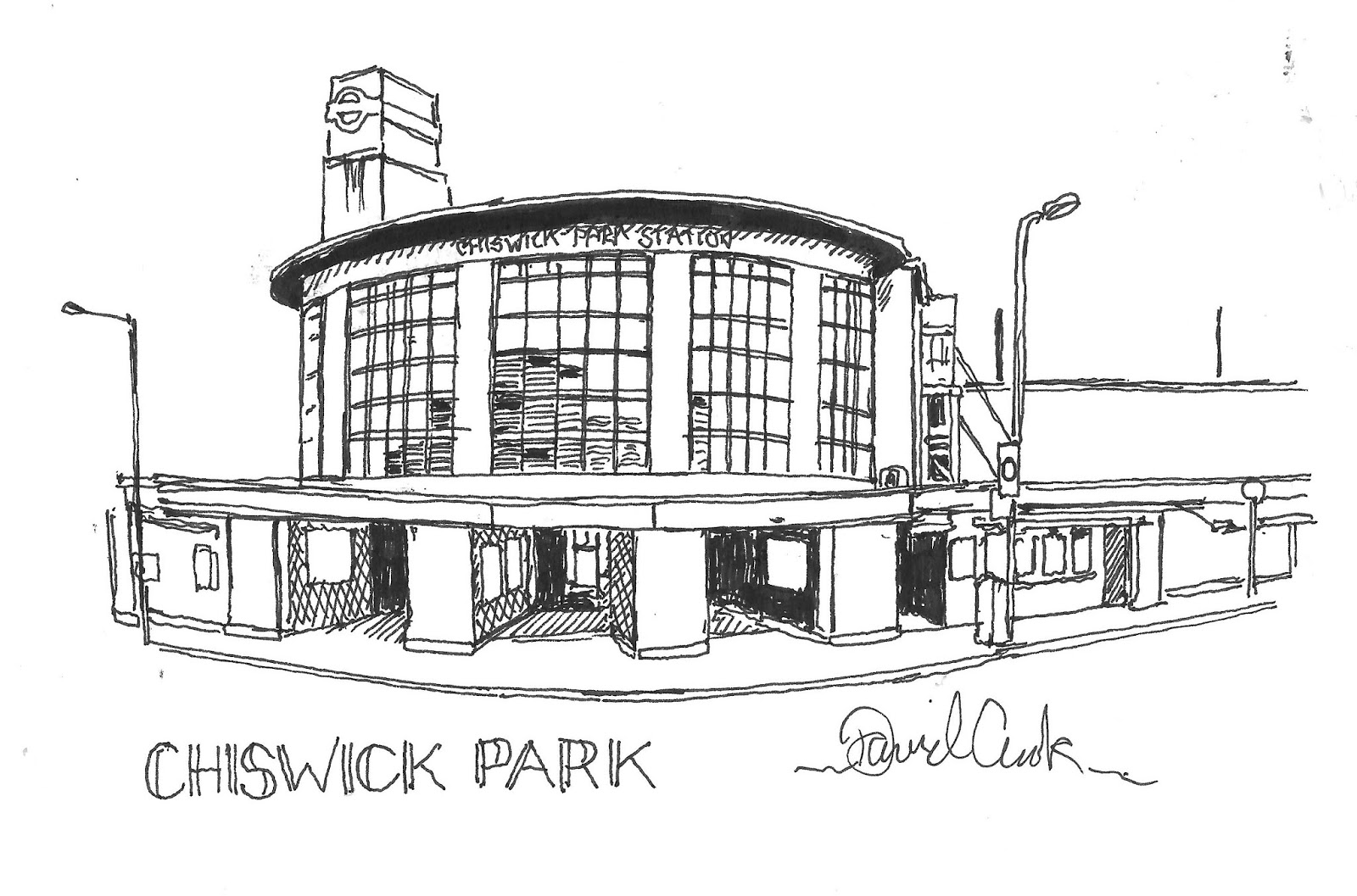
Chiswick Park, on the other hand, has much to appeal to the eye. Research suggests that Charles Holden’s design was inspired by Krumme Lanke U Bahn station in  Berlin. Well, I never visited that station when I was there. Photographs suggest a resemblance in the sense that they’re both modernist designs, with semi-circular features, but not much more similar than that. Chiswick Park has the brick, glass and concrete so typical of Holden’s other designs. I definitely remember Piccadilly Line trains stopping at Chiswick Park when I was a kid, but I believe that they never stop there now, and that this is the only station on the Ealing Broadway arm of the District Line that is exclusively for the District Line.

Mind you, for most of the day Piccadilly Line trains don’t stop at Turnham Green either, only early and late. Turnham Green is one of very few Underground stations to share its name with a battle. In this case, the Battle of Turnham Green was the opening battle of the English Civil War. Despite such historical connections, though, Turnham Green Station really isn’t worth getting off the train for. Luckily, this was my walked section, and it took slightly less than 15 minutes along Acton Lane and Hardwick Road. I was unable to discover when it was built, but the whole thing is like a large shed tacked onto the side of the viaduct which carries this raised section of track between Acton Town and Hammersmith. It’s a little reminiscent of the old building at South Ealing. If you look at the sketch I’m sure you’ll appreciate why I didn’t want to linger here either.


10 minutes walk and I arrived at Stamford Brook station. This one dates back to 1912, and I have to say that I rather like it. The only notable thing that I found out about it is that in the year I was born it had the first automatic ticket barrier in the network installed. The station is about the same sized as a cosy suburban house, but the semi circular gable gives it an air of importance, as does the ornamentation on the brickwork. I considered getting back on the train here, but decided to push on.


Again, it only takes about 10 minutes to walk between the two stations, and the last five minutes of this were through a very pleasant little park – possibly the park from which Ravenscourt Park station takes its name. I was actually rather surprised by the size of the station’s ticket hall when I approached it. This is another of those stations I’ve passed through many times, but never actually walked into or out of. I haven’t been able to find out when it was built, but I’d imagine that it’s earlier rather than later. It may even be the original building from 1873. 

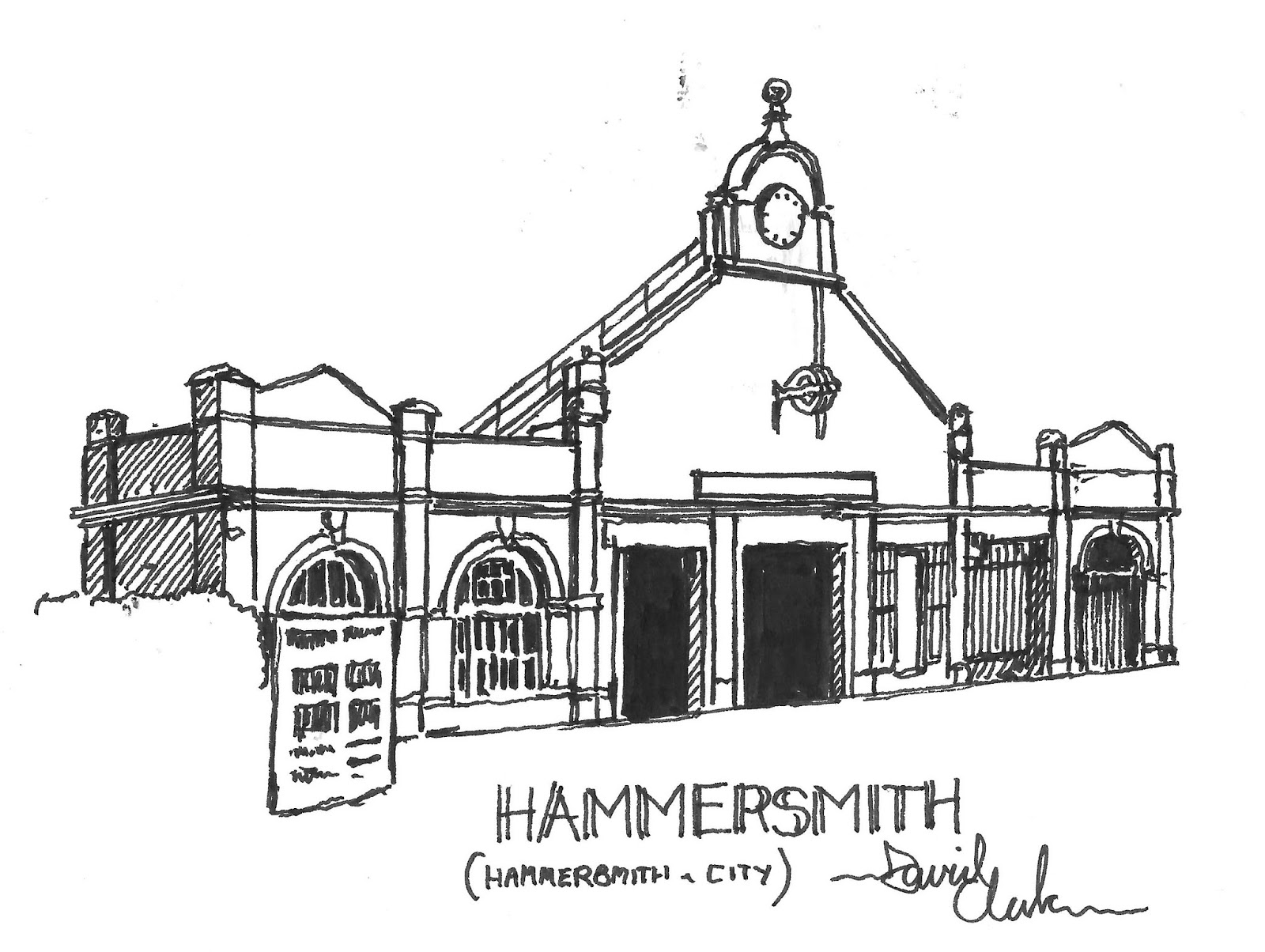
Having bagged 4 – or if you count Gunnersbury, 5 stations, I decided that the best thing I could do was get the District line to Hammersmith, short journey though it is. I’ll be honest, I didn’t want to arrive at Hammersmith on foot, because there is no station building now, as such. The station is entered through a 1990s shopping mall. Which I swiftly left, because I wanted to go to Hammersmith station. Let me explain that. There are actually two Hammersmith stations, the District and Piccadilly Line station, and the Hammersmith and City line station. This latter station is well worth a short walk to visit, even though I wouldn’t actually be doing the Hammersmith and City Line for quite some time. For one thing it was the oldest station building I’d yet sketched, dating back to 1868. I have family roots going back to my 3x great grandparents in Hammersmith, and it’s pleasing to me to think that they would have been familiar with this very building. Amazingly, though, this wasn’t the first Hammersmith station, since the original was built a short way north, in 1864.

Now, let’s talk about Baron’s Court. I have passed through the station many times, but never ever alighted there. In fact to me, Baron’s Court was just a name, and a set of distinctive red benches. So you might imagine how surprised I was to walk out of the station, and find this frankly beautiful station building. It slightly predates Leslie Green’s stations, although I venture to say that you can see some of the features that Green himself would adopt and adapt. This station was designed by Harry Ford, who was the chief architect of the District Railway from 1900 until 1911, so his career overlapped somewhat with Leslie Green’s career as chief architect of the Underground Railways Company of London.

Another district line detour next, I’m afraid. The Piccadilly Line goes direct from Barons Court to Earl’s Court, but it does this through nipping underground on the approach to Earl’s Court, while the District Line manages to squeeze in another stop at West Kensington. I don’t honestly think that West Kensington is the kind of station you’re ever likely to be drawn to for its aesthetic qualities, and the only reason for me to take the detour was that it was a very convenient way of lightening my District load a little when the time came. Apparently it is a Charles Holden design, but I have to say that it’s one of his least effective.

Well, that’s Holden. Going back to Harry Ford and Leslie Green, if you want to see an overlap of their two styles you just need to go to the next station on the line, Earl’s Court, since this was a collaboration between the two men. Well, the façade was, anyway. The main part of the station is John Wolfe Barry’s from the 1860s. As for the façade, well it has the familiar semi circular windows of Leslie Green’s stations, but the terracotta tiles are much lighter in tone than his trademark ox blood tiles, and in fact the tiles of both Earls Court and Barons Court are far more similar in tone to those on the front of the Natural History Museum. Research suggested that it would be worth walking through the station to take a look at the other entrance on Warwick Road. This was built in 1937, and space was added for offices on the roofs in the 60s. Which is a bit of a shame, since the coloured glass screening obscures a lot of the original 1930s features, which I find more pleasing on the eye.I did consider making another District Line detour at this point, to Olympia. However, from my ays of visiting a friend who lived within sight of Olympia, I recalled that it’s only a short walk from High Street Kensington, and so it made more sense for me to leave it until the District Line as part of a walked section.

I don’t know for certain that the District Line station building for Gloucester Road station is the original, but I’m pretty sure. The moulding below the ornate cornice and balustrade on the roof of the building declares that this is the Metropolitan & District Railway. It’s a pretty, Italianate construction, with a rather lovely glass canopy above the entrance. The two small wings on either side give the whole building a pleasantly symmetrical, pretty much palladian appearance. This is enough beauty for any station, and yet there is also the Leslie Green station building as well, built for the opening of the GNPBR. It’s the first station on this challenge to feature the famous ox-blood terracotta tiling, but to my mind it looks slightly unbalanced and less harmonious than the typical Leslie Green stations, since the first storey abruptly ends before the ground floor does. 

One other feature of the station is that the disused Circle line platform houses an Art on the Underground exhibition. Since we’ve been speaking of exhibitions, it’s ironic that the next stop is South Kensington, since it’s famous as the tube station for the Science Museum, the Natural History Museum, and the V and A, which it can be claimed all had their genesis in the Great Exhibition of 1851. I remember back in the early 80s being surprised to discover that there is actually a street level station building, since every time I’d used the station prior to this I’d taken the pedestrian subway to the museums, and these just emerge from glorified holes in walls. As for the station building, which is a few streets away from Exhbition Road and the Museums, well, the first thing you notice is the façade of the original turn of the century GNPBR Leslie Green station. However the actual entrance to the station is through the Metropolitan and District entrance. I have to say that the elegant columns really aren’t well served by the blocky generic blue canopy bearing the stations name, which just serves to distract from the delightful ornamental metal work between the columns with the station name and the Metroplitan and District Railway. It’s a bit like a gentleman in his 80s sporting an electric blue Mohican. 

At this point in the trip I parted company with the District and Circle Lines, and continued with the Piccadilly to Knightsbridge, probably best known as being the station you get off at for Harrods. The original 1906 Leslie Green main entrance went the way of all flesh in the 1930s, although the former rear entrance in Basil Street, with its ox blood tiles and all, still exists as part of an office building. In the 1930s the station was remodelled to install escalators to the platforms, and it was necessary to demolish the ticket hall, and built the one which stands there now into the corner of an existing building. So either you take the building as a whole and say that it’s one of the most impressive station buildings, or you’re honest and say that the station building is just a small part of this and it’s really not that much to write home about
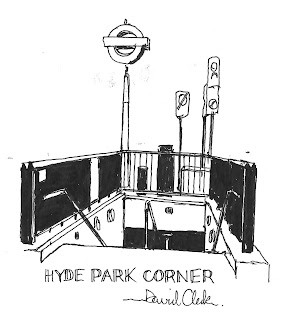

Which still makes it more impressive than our next stop, Hyde Park Corner. This is our first hole in the ground type station, and as you can probably see from the sketch there is little attempt at sweetening the pill, or humanising the dirty concrete with any sort of canopy, a la the Paris Metro. The sad thing is that the original station building, a Leslie Green 1906 effort still stands on the south side of the road junction. As with Knightsbridge, the building proved an obstacle to the installation of escalators in the 1930s renovation, and was closed and replaced with a completely underground ticket hall. That about wraps it up for Hyde Park Corner, and I have to admit that even though I’d already ticked off my between station walk, with the sun shining I decided that a walk along Piccadilly to Green Park might be pleasant. 

Indeed it was, too. I will admit to a brief detour along Down Street to see one of the more famous of the London Underground’s ‘ghost stations’. Down Street was originally a stop between Green Park and Hyde Park Corner, which opened in 1907, and closed, due to lack of use, in 1932. The Leslie Green station building still remains, but probably wouldn’t be much remembered other than for the fact that it was used by Winston Churchill as a bunker during World War II. Apparently it is possible to access the underground levels of the station, and occasionally London Transport has allowed the privileged few to do just that. Well, I’m not one of them so after pausing to buy a paper from the shop which occupies part of the building, I pressed on to Green Park. 

Green Park is another of those Piccadilly Line stations which acquired a subterranean ticket hall in the 1930s, although the entrances are at least a bit better than Hyde Park Corner’s. The main entrance is accessed through a building which houses, amongst others, retail outlets including Marks and Spencers. It also has its own hole in the ground entrances. The hole in the ground entrance on Piccadilly has a rather  uninspiring concrete shelter  above it, while there’s another 21st century entrance through Green Park itself, and I have to say that for all its simplicity, I rather like this entrance. 


I was already well aware that the large booking hall of Piccadilly Circus station was underground. The original Leslie Green station building closed in 1929, yet it continued to stand until being demolished in the 1980s. Shame, especially since it means there are no surface buildings associated with the station now. At least each of the 4 entrances has a rather imposing gate way consisting of ornamental lamps and metalwork with the Underground sign over head between them. 


The Piccadilly Line stations come thick and fast above ground on this section of the line, and I knew for a fact that I could walk from Piccadilly past Leicester Square to Covent Garden a lot more quickly than I could take the tube between stations, get out at each and then get back on the train again. So continuing the above ground walk was a no brainer. Besides, this is a part of London I used to spend a lot of time in when I was at university, so it was no hardship to revisit old stamping grounds. Much of the original Leslie Green Leicester Square station faced still exists, even though the station has a subterranean ticket hall now, and there’s a steak house restaurant inside most of the original building. On the opposite side of the Charing Cross Road, on the corner of Charing Cross Road and Cranbourne Street steps emerge from a rather blocky, 1930s building next to Wyndham’s Theatre. 


Leicester Square and Covent Garden are well known as the closest stations on the Underground, although I somehow doubt that they’re the closest street level station buildings. Nonetheless it didn’t take long to walk to Covent Garden. When I was a kid, the London Transport collection and museum were temporarily housed in Syon Park in Brentford, at the end of the E1 bus route from opposite Elthorne Park. In 1980 though the Museum moved to its permanent home in Covent Garden, and I dare say that if you’re reading this book, which you are, then a visit would be something you’d enjoy. The station, at the corner of Long Acre and James Street, is the original Leslie Green building, and is , in my opinion, one of the finest of his oeuvre. The corner site gives it a really pleasing
appearance, albeit that the later building placed on top of the station does little to enhance its charms.


At this point I hopped back on the train for the last few stops before the end of this trip at King’s Cross. The next stop was Holborn. Holborn is, to be honest, a bit of an ugly duckling in my opinion, although it shows precious few signs of turning into a beautiful swan. The original station was built by Leslie Green, however turn of the century planning regulations demanded that all buildings on Kingsway should be faced with stone, and so there’s none of the famous ox blood terracotta tiles. In the 1930s modernisation parts of the Leslie Green facades were replaced by come of Charles Holden’s least appealing structures. Portland stone and glazed screens in order to accommodate a new ticket hall and escalators. The remaining parts of the Green station buildings now house retail outlets. 

The opening of Holborn eventually rang the death knell for the former British Museum station, which was just a couple of hundred metres away. Prior research showed that sadly the remains of the station building were demolished in 1989, so there was no point in me looking for it. Not so the disused Aldwych station. I mention it here, because there was a short branch line between Holborn and Aldwych. I did consider walking to the splendidly
restored Leslie Green station on the Strand, but time was getting on, and not to put too fine a point on it, I was knackered. I made the decision to try and accommodate the station on a future trip, but being as its not an any active line now, I wasn’t going to lose much sleep over it.

My penultimate stop for the day was Russell Square, and a fine, original 1906 Leslie Green building. It was on the line between Russell Square and Kings Cross St, Pancras that an explosion, part of a terrorist attack , took place on a train in 2005. There is a plaque remembering the victims in the station. I considered calling it a day then and there, but made up my mind to push on to my original objective.

Apart from anything else, once I’d ‘bagged’ King’s Cross St. Pancras, it would mean I’d also have one less stop to worry about on the Metropolitan, Circle, Northern, Hammersmith and City, and Victoria lines as well. 
King’s Cross is where the Piccadilly Line intersects with the first underground line, since Kings Cross, which had originally opened in the 1850s, was one of the stations on the route of the original Metropolitan Railway in 1863. I tend to associate the main line station building with the name, however the underground station does at least have a distinctive modern, 21st century entrance, opened as part of wholescale redevelopments in 2009.


Including Down Street, Gunnersbury and the stations between Acton Town and Hammersmith this had been a marathon trip of no fewer than 21 stations.

Catching Up . . .

Been a while, hasn't it?  Don't worry, I haven't given up sketching. No, I just haven't got round to posting anything. Now, ...