Saturday, 8 February 2020

Central Line Section 3: Wanstead to Epping


I start at Wanstead, bright eyed and bushy tailed. I’ve never travelled on the Hainault loop before – in fact I’ve never visited any of today’s stations before, and so we have the excitement of the new if nothing else to sustain us through today’s trip. 


This is an excitement which even the rather run down and depressed appearance of Wanstead station does little to dampen. I use my phone to google the station on Wikipedia and I’m surprised to see that it’s a Charles Holden design. Maybe I shouldn’t be, bearing in mind the tower, which thus far has seemed a feature only used by Holden and followers of his style. I suppose it’s the drab colours, and the lack of glazed panels – although there are some on the other side of the tower that I discover when I take a quick walk around the outside. Like many Central Line extension stations, this one was started before, but not finished until after World War two. Before reaching the station, we went underground, which I really wasn’t expecting this far out of the centre of London – it’s one thing for a tunnel to continue out into the suburbs, but quite another for one to start like this.

Thus prepared by the previous station, I’m pretty ready to identify Redbridge as the work of Charles Holden. For one thing the red brick tower with the glazed panels is clearly either the work of Holden, or of someone consciously using his style. Then there’s the glazed circular booking hall rising above the entrance – it isn’t as imposing as Arnos Grove, but then few other stations are. I’ll be honest, it’s a very short journey from platform to street level considering that this is a ‘tube’ that is deep level station as opposed to cut and cover, which it feels much more like. Still, let’s concentrate on the exterior. The canopy with the station name and the entrance underneath it both gently curve around the booking hall, and all in all it creates a very pleasant and harmonious appearance. I’m not surprised when Google coughs up the information that it is in fact a listed building.

I have a lot to say about Gants Hill Station, very little of it about the exterior though. Basically the station is underground, with entrance made via pedestrian subways from the roundabout above. That’s it. However, inside, that’s far more interesting.

This is one of the last stations designed by Charles Holden. Now, going back to the 30s, the engineers of the Moscow Underground, now the busiest in Europe, were very interested in getting ideas from London, and I believe that Charles Holden himself was consulted. Okay – one result of the Russian engineers’ visits to London was that the word ‘voksul’ was adopted for metro stations in Russian. Why? Because, allegedly, they believed that Vauxhall, as in Vauxhall station, meant station. I’ve yet to find any proof to the contrary of this idea. Holden himself was inspired by the designs of the station interiors on the brand new Moscow metro, and this bore fruit with the interior of Gants Hill. The spectacular barrel vaulted concourse with its art deco uplighters immediately transports me back to memories of bad spy movies, and I half expect the gentleman sitting on the other end of the bench to sidle up to me, and whisper “I hear that in Leningrad the weather will be clement.” in an Eastern European accident. I’m mildly disappointed when he doesn’t.

However, it’s hard to be disappointed when the sun is shining outside in the world above, and each station is offering something different. This is certainly true of Newbury Park station. Now, strictly speaking, the interesting concrete structure isn’t all the station entrance, but rather a bus shelter containing the station entrance, and more importantly a grade 2 listed bus shelter. Now, I’ve no idea how many bus shelters are listed buildings, and if you know, please don’t write in and shatter my illusions. But I will admit that when I hear the words ‘listed’ and ‘building’ , then bus shelters are not what are usually conjured up in my mind’s eye. This is a remarkable structure though. Designed, not by Charles Holden, unsurprisingly, but Oliver Hill, the concrete arches hold up a copper covered roof. Now, I’ve very sorry but I do like a copper covered roof, which probably has something to do with the fact that the church in which I was christened, St. Thomas the Apostle in Hanwell, has one. I love the shade of green that copper goes when it reaches a certain age, as shown by the Statue of Liberty in New York. Many people don’t know that it’s made out of copper sheeting over a steel frame, and that for years after it was first erected it was actually copper coloured. Coming back to Newbury Park, the building was originally designed in the 30s, and seems a remarkably futuristic design. Oliver Hill himself had designed other wonderful art deco buildings, including the masterpiece Midland Hotel in Morecambe. Newbury Park is our second station to have won a design award in the 1951 Festival of Britain, probably because it wasn’t completed until after World War Two.

If this part of the Hainault loop had a motto, it might well be – and now for something completely different, since Barkingside, the next station, is precisely that. Well, completely different from the stations that have preceded it anyway. It’s very much the oldest looking station we’ve encountered so far on this particular trip. Barkingside looks like an Edwardian national railway station, which is exactly what it started life as. Google coughs up the gobbet of information that it was opened in 1903, and probably designed by the Great Eastern Railway’s chief architect, W.N. Ashbee. What’s not to like here? Well, the concrete rendering which reaches about a third of the way of the wall of the main part of the building doesn’t do much to enhance the appeal, but other than that, it’s the kind of thing that’s always pleasing to my eye. I especially like the cupola on the roof directly above the entrance. The whole thing is just a little reminiscent of my primary school. I shouldn’t be really surprised about this, since there was a spate of school building in England and Wales during the last few years leading up to the First World War. Both my primary school, and two of the blocks in the school in South Wales in which I taught for almost 30 years were built in 1913. And having loved my time in both of these schools, looking at this kind of architecture brings on a pleasant glow of nostalgia.

In a way it’s a bit of a shame for Fairlop that I visit the station straight after Barkingside. I alight under beautiful white painted wooden Great Eastern Railway canopies, and my expectation is that this is going to be my second Edwardian railway station in a row. Stepping outside this prediction is confirmed, and it’s a perfectly nice little station, other than the fact it’s not as impressive or quite as decorative as Barkingside, which we’ve just visited. It’s a bit of a shame, since the platforms themselves are amongst the nicest I’ve seen on the Central Line at all. Everything looks freshly painted. The iron work holding up the canopies is gorgeous, and for a moment I am tempted to start acting out a scene from The Railway Children. My Jenny Agutter impression hasn’t improved with age, I’m afraid.

Well, after such a run of fine and interesting stations, we had to be brought back to earth at some time, and Hainault achieves this. It’s not that it’s ugly, but just that it’s nondescript, which makes it difficult when you’re trying to descript it. To be fair, it’s difficult to think of any of the stations I’ve seen which has really benefitted from being built on the side of a viaduct or a raised section of line. I liked Greenford for example, but I don’t mind saying it might be even more appealing if it was completely free standing. Coming back to Hainault, its layout and materials resemble a Charles Holden entrance hall, but without the benefit of a trademark Holden ticket hall. The cast iron bridge casts over half of the entrance in what I’d guess is a perpetual gloom, and although the façade is brightened by the map and several posters, it doesn’t have any windows, which is a shame. I’ll tell you something else which is a shame. I always thought that this part of the world took it’s name Hainault through some connection with Queen Philippa of Hainault, wife of King Edward III. Apparently not. The spelling was changed from Hyneholt in the 1600s because of a false connection to her. Hyneholt, well, I’m not sure about the Hyne bit, but I know from my days studying Old English at University that holt – as in Northolt – means wood.

Talking of evocative names, the next station, Grange Hill, brings back memories of a long running school based TV drama series, with which it sadly has absolutely no connection. My meagre research has thrown up a couple of facts about the station itself. Work started in 1938, but wasn’t completed until after World War II. Heard that before? Of course. Well, how about this one. The station was hit by a V1 flying bomb ‘doodlebug’ in 1944. Another thing to add to the long chapter one could write about the London Underground in wartime. As it stands today, the station looks Holdenesque, ersatz rather than genuine Holden. I was unable to find out who actually designed it. From the canopy down, it’s Holden, but the ticket hall rising above and behind the entrance just doesn’t look quite right. It’s a little too low, and has windows all around rather than the glazed panels you’d expect from Holden. It’s perfectly alright as a building, but sadly, by following a Holdenesque plan this ends up just drawing attention to how it just isn’t quite as nice as a Holden station.

Well, from ersatz Holden we move now to another original 1903 building, but this time in a quite different style from Fairlop and Barkingside. The name Chigwell, to people of a certain age probably conjures up images of Sharon, Tracey and Dorian from the long running BBC sitcom ‘Birds of a Feather’ which was set in Chigwell. This sets me off on a train of thought, as to whether it would be possible to construct a Comedy Line linking underground stations which have a connection with comedy programmes. Immediately East Acton comes to mind – it was nearby Wormwood Scrubs prison which was used for the prison exteriors on the opening sequence of the 70s sitcom Porridge. Shepherd’s Bush for Steptoe and Son, and Tooting Broadway for Citizen Smith followed fairly hot on it’s heels. Reluctantly I drag myself from this pleasant reverie, and file it away for something to amuse me back on the walk from Roding Park to Buckhurst Hill. Which is not to say that Chigwell Station is not worthy of attention itself, because it very much is. Built for the Great Eastern Railway in 1903 I doubt very much that its changed much in the interim. I can’t help wondering whether the window frames are original, because they look very plain for the era. That doesn’t really bother me though, because above the canopy the façade has a pair of matched dutch gables. I love a dutch gable on an Edwardian or late Victorian building. So you can imagine, I was like a pig in clover on a  recent visit to Amsterdam. Even though I’ve never visited the station before, if I was to make a list about stations which have been connected to important things in my life, I would include it, because this is where Miss Walker lived – the area, not the station – before she became Mrs. Clark.

I’ve thoroughly enjoyed my journey around the Hainault loop, but I’m quite happy to leave the train and begin my walk at Roding Valley. Actually the sooner the better, since Roding Valley station itself veers more towards the eyesore than the sight for sore eyes end of the attractiveness of stations scale. It’s a single story, orange brick building, and like a lot of the Central line extension buildings it was commenced in the late 30s, but not completed until the 40s. It certainly looks like a 1930s building, but with a style such as modernism or art deco, because the buildings are relatively minimalist in terms of decoration compared to earlier public buildings, the details are vitally important, and if you get one thing wrong it can spoil the appearance of the whole building. So having a window boarded up has a really poor effect on this one.

Thankfully I have neither the excuse nor time to stand around looking, as I step off towards the main eastern arm of the Central Line, and the next station, Buckhurst Hill. There’s a definite spring in my step. The sun is still out, I’ve eaten my packed lunch, and there’s just five more stations to see before I can add the Central Line to my completed list. This is a mood which a leisurely half hour walk, and the sight of Buckhurst Hill station does nothing to dispel. It’s a very pretty little W.N. Ashbee Great Eastern Railway station from 1892, the oldest on this particular trip so far. Certainly when I visited the façade looked to be immaculately maintained with some gorgeous ornamental brickwork around the shallow arches of the windows. I’d lay odds that these windows aren’t original though, but hey, you can’t have everything you want all the time. I’m tempted to make an on the spot sketch of this little gem like building, but in the end decide that it would be more sensible to rattle off the next four stations in good time.

Even having a decent knowledge of the underground, as I like to think I do, I’m still capable of being surprised by what I see sometimes. My ignorance about this end of the Central Line, works to my advantage as I exit Loughton station and find I’m absolutely blown away by its design. It is unlike anything I have seen on any of the trips I’ve made so far, and I strongly doubt that there is another station on the network that is quite like it. And yet . . . Then it strikes me, the huge semi circular window above the entrance, in a rectangular block is a little reminiscent of the façade of King’s Cross station, albeit that has two windows, and towers at either end. Here’s the funny thing. The façade of King’s Cross is much, much older than Loughton, yet Loughton was actually designed by the LNER’s architect, in the 30s, John Murray Easton. King’s Cross, of course, was the main terminus for the LNER in London at this time. It isn’t what I would call a beautiful station, in the same way that King’s Cross is not a beautiful station if you’re comparing it to the yardstick of the Great Midland Hotel looming over neighbouring St. Pancras. But it is striking, almost magnificent in a way.

This rather makes me fear for Debden station. I just can’t seeing it living up to Loughton, and so in a way I’m quite pleased when I exit the building to see that it doesn’t really try. Its façade, which is something of an elongated shed with a flat roof, is at least enlivened by the raised ticket hall. However this itself is so low that it tends to peep rather apologetically over the station canopy. It’s glazed all around rather uninterestingly, and I can’t help wondering for a moment or two whether it might in fact be a later addition to the station. Taken all in all, the air of the station is of a building mumbling ‘nothing to see here citizens, get on with your lives.’ That’s fine by me, and I take advantage of this good advice, since the next station has one of the more sonorous and intriguing names of any station on the network, and I’m looking forward to seeing if the station building can live up to the promise of the name.

Having studied French, after a fashion, to A Level I’d always pronounced the Bois of Theydon Bois as ‘bwah’. It made sense to me. Bois is French for wood, and the next station is Epping, as in Forest. Some time ago, though, I was reliably and authoritatively informed that in the name of the station, Bois is pronounced to rhyme with noise. As I walk out of the train onto the platform I find that I am unable to stop myself from singing “Theydon Bois, Theydon Bois, laced up boots and corduroys.”A gent who looks to be of a similar vintage to myself smiles at me. For those who aren’t of a similar vintage to myself, I suggest you ask your parents, or failing that, your grandparents to explain that reference. Speaking of which, according to Wikipedia, the village has always been pronounced Boys or Boyce, and derives its name from the family who held the manor in the 1300s. Interestingly it was the railway which fixed the spelling at Bois. When the Great Eastern built their station here, the local parish clerk suggested this would be the best spelling, bearing in mind nearby Epping Forest. I apologise to those of you reading this who are currently thinking “I don’t need to know that, kindly leave the stage” but the fact is that I love finding out these little obscurities.

As for the station building itself, I can’t for certain say when it was built. Looking at it, I somehow doubt that it’s the original, since the window frames and the ornamental brickwork on some of the corners suggest a similar vintage to the 1903 stations we saw on the Hainault loop. It’s a pleasant place, although I can’t help wishing that the two storey building on the right had been left its original red brick rather than being painted with the brilliant white that it sported during my visit.

Epping is a name I once used in a long poem I wrote at University. Without going into too much detail, Dream Vision Poetry was a genre of poetry practiced in the 14th century by Chaucer and some of his contemporaries. It inevitably involved the voice in the poem being spirited away in a dream, often to an idyllic, Eden-like setting which we would call by the latin term – locus amoenus. Got that? Okay, so in this poem I wrote,

“I looked to try and see where I was stepping.

I guessed locus amoenus, maybe Epping.”

This was more for the rhyme than anything else, since I’ve never been to Epping before and have absolutely no idea whether it’s a locus amoenus, a locus horribilis, or something in between. Actually, that’s still true, since I confine my perusal of the surroundings to the station buildings itself. They’re rather nice, rather reminiscent of Theydon Bois, although something of a mirror image since the two storey wing is on the left this time. Once again, I’m unable to conjure up any specific dates of construction, or architects’ name on the phone, but as with Theydon Bois I’m pretty happy that it’s Edwardian or late Victorian, which would make it originally a GER station. Which is where the line ends, or at least, where it has ended since 1994. In that year, London Transport ended the single track service between Epping and Ongar. I was always intrigued by this on the map, as I have memories of it being represented by a read and white line, and looking for all the world like a horizontal barber pole. The memory my be cheating me on this one, I admit. There have been short lived attempts to run services by private companies from Epping to Ongar since, but since that’s not part of the underground network now, I don’t concern myself with it.

-----------------------------------------------------------------------------------------------

Three cheers for the Central line! The longest journey you can make without changing trains anywhere on the network is from West Ruislip to Epping, which is slightly more than a whopping 34 miles. This makes me even happier that I didn’t make a rule that I have to walk between every station. If that were the case then this challenge would take years rather than the months I’ve allotted for it. It has the 4th greatest number of stations, after the District, Piccadilly, and the Northern line which boasts just one more. Not including Osterley and Spring Grove, which is no longer a station, I’ve now sketched 155 stations. That’s 57.4% or 31/54. I think a small celebration might be in order.

It’s fairly obvious which line I need to tackle next. There are 50 stations on the Northern Line, only five of which I’ve already visited on other lines. That splits nicely into three trips, and more importantly, it should take me to 200, leaving only a measly 70 to do on the remaining lines.

Saturday, 1 February 2020

Central Line Section 2: Bond Street to Woodfiord


Central Line – Section 2 – Bond Street to Woodford

I had to give this one some thought. At the eastern end of the Central Line it makes that nasty little complete loop before it joins itself back and continues to Epping. I had a think about how I could avoid having to double back on myself. The first solution that I came up with was to do the 16 stations to Woodford. Which would have worked for the last trip if it was possible to go directly from Roding Valley to Epping. It ain’t. However, it is possible to walk between Roding Valley and Buckhurst Hill station in about 20 minutes. Bingo. So for the second section, Bond Street to Woodford it was.

Looking at the line there were two fairly innocuous walking routes which occurred to me. Firstly, Bond Street to Tottenham Court Road via Oxford Circus, and secondly Chancery Lane to Liverpool Street. Fatigue and time permitting I decided to try to give both a go, but deferred a final definitive decision until I reached Chancery Lane.

I passed by the Marylebone Road entrance to Bond street, which I believe was opened as recently as 2017. The first time I passed by New Bond Street, when I was a kid, I was really surprised how insignificant it appeared, bearing in mind its preeminent position amongst the mighty dark green properties on my beloved Monopoly Board. It was only years later that I found out that Mr. Waddington, who had licensed the original Monopoly game from the USA, didn’t know London at all, and he only spent a very brief time on a visit deciding which London properties he could replace the original Atlantic City ones with. Hence the inclusion of Marlborough Street – which I believe only ever existed as Great Marlborough Street. It might also explain why the south of the river is even more poorly served by the Monopoly board than it is by the Underground – only poor old Old Kent Road , which to add insult to injury is also the cheapest property on the board.


I’ll be honest, I’m glad that I’d decided to walk this section. Oxford Circus is one of those stations which is better off being looked at than actually used. For one thing, you can only exit through the station buildings. To enter you have to use the stairways on Oxford Circus. For another thing, while the Leslie Green and Harry Bell Measures exits are picturesque, and both of them are listed buildings, they’re not always adequate for the number of people trying to exit the station at the same time. It’s not really surprising. The station opened before Harry Selfridge opened his little shop on Oxford Street, and maybe it was the proximity of the stations which pushed him in that direction. Whatever the case, the proximity of Selfridges, John Lewis and other top stores to the station has meant that it has had a pretty heavy footfall for longer than I can remember. At the best of times Oxford Street itself is crowded, but at least I find that I’m carried along with a wave of humanity to the end of the street, and the next destination.

Tube stations come thick and fast in this part of Central London. It’s only a short walk along the Charing Cross Road and Tottenham Court road to Leicester Square station, and Goodge Street on the Northern Line is only about 5 minutes’ walk away in the opposite direction. I used to use Tottenham Court Road station to visit Foyles,
one of my favourite London bookshops in the early 80s, and the original Forbidden Planet, my absolute favourite bookshop of the early 80s. All of which is, I suppose, a way of stalling for time before I pass comment on the new station which was opened in 2015. Cards on the table, it doesn’t do as much for me as, for example, the modern station at Hounslow East. Still, there has at least been some effort to here to give the eye something to latch onto. The profile, gentle sloping downwards from the apex appeals far more than a flat block would have done, and having the whole of the façade above the entrance itself made of glass panels is all to the good. I do think that glass panels on the side of the building might have helped, though, and I wonder what the place will look like in another 10 or 15 years time, especially if the maintenance budget is cut. Probably better than the nearby Centrepoint Tower from the 60s.

In the course of my Piccadilly Line and District Line trips I ended up sketching 5 stations which are also on the Central Line, and the next, Holborn, is one of them. So we’ll pass over, while just noting that one of the better known ghost stations, the Central Line’s British Museum station, was actually killed off by Holborn. There’s no overground trace of where the British Museum station entrance actually was – well, I couldn’t find one, anyway. So I’ve read, the original Harry Bell Measures station building survived until the late 80s. The platforms are gone, and so am I, moving swiftly on to Chancery Lane.

As is not uncommon with London Tube Stations, Chancery Lane is only close to the thoroughfare from which it takes its name, but not actually on it. The lane itself takes its name from the old court of Chancery. I studied English Literature at University, and have taught it since, and am a lifelong fan of Charles Dickens, so the name inevitably conjures up one of Dickens’ greatest novels, “Bleak House”, with the seemingly endless court case of Jarndyce v. Jarndyce winding its way through the court with glacial slowness. There is a station building on High Holborn, but it’s disused. It certainly looks like the work of Harry Bell Measures, but my brief research didn’t reveal if this is actually the case. The current ticket hall is accessed via staircases which looked pretty similar to those of Notting Hill Gate.  

Time looked fine, and I still had the hwyl necessary for the job, so I walked from Chancery Lane to our next station, St. Paul’s. Now, here’s a fact about the station you might not know. When it was first opened, this station was actually called Post Office, since it was close to the headquarters of the General Post Office – where novelist Anthony Trollope worked for part of his career. Now, look, if I’m being honest I’m probably too quick to mourn London’s lost buildings, but I do think that it’s a shame that the original GPO headquarters, a magnificent neo classical design by Robert Smirke, was demolished not that long after the station opened. Still, one thing you can say about the area immediately around St. Paul’s Station is that you’re not short of an imposing building or two. Which brings me to Temple Bar. In the 1870s, Christopher Wren’s original Temple Bar gateway was removed from the strand to make way for the Law Courts. In the early noughties a long standing campaign to reinstate the arch, which had stood in Theobald’s Park in Hertfordshire in the interim, came to fruition. The bar was reerected at the entrance to Paternoster Square from Fleet Street. And sadly, in my opinion, it is absolutely dwarfed by the buildings on either side, and not seen to its best effect. I saw the Bar in Theobald’s Park a day or two before demolition started, and it’s difficult to believe that the Bar now isn’t a smaller scale model. Back in the park it was rather dilapidated, but it stood in solitary majesty, while now, it’s been splendidly restored, but can’t help looking a little sorry for itself in its position.

We called in on Bank when we visited Monument station on the District, so I don’t let it detain me much. I can’t help liking this part of the City though. Everyone should walk through the financial district of the city on a weekday lunchtime, and then walk through it at any time on a Saturday, so they can marvel at the ghostliness of the place at the weekends. Besides, Liverpool Street, where I plan to get back on the train, isn’t far away at all. When I’m this close to London Bridge I can’t help an irresistible urge to spout facts about it. For example, the closest church to Liverpool Street station is St. Botolph’s, Bishopsgate. When the original stone London Bridge – the one which had buildings on it until 1760 – was demolished in 1831, the railings from the Bridge were placed around the churchyard. I don’t think they’re the railings there now – maybe they were melted down during world war II.

As you know, Liverpool Street is also a mainline railway terminal, and while the entrance to the tube station isn’t as understated as Victoria’s, it’s not as flamboyant as the District station at Paddington, or the new station at King’s Cross. The street entrance is curved around a corner, which is probably its best feature, and a pair of unadorned columns either side of the entranceway support the curved canopy. The yellowy slabs above the canopy really don’t do a great deal to enhance its appeal. However, it’s a station I rather like for another reason, since it also ticks off a station for both the Hammersmith and City Line and the Metropolitan. I don’t mention the Circle Line, since all of the Circle line stations will be covered when I’ve completed all the other lines.

In well over 100 stations so far we’ve seen a very small number of stations whose sole entrances are Bethnal Green is another of them. Sadly, Bethnal Green station’s claim to fame is as the scene of the biggest ever loss of life on the Underground. On the evening of 3rd March 1943 an air raid warning sent people rushing to the shelter. A woman and a child tripped on the stairs, causing others to fall around her, as the crush of people pressed downwards. 173 people lost their lives that day, and 60 others were injured. News of the tragedy was hushed up due to wartime restrictions, and there was no enquiry until after the end of the war. I first became aware of this when taking my now grown up daughters to visit the nearby Museum of Childhood – another benefit to London brought through the 1851 Great Exhibition via the V and A- and read the plaque which stands as a memorial in the station.
via stairways down to holes in the ground, but

So it’s in still rather a sombre mood that I pass through Mile End station. I don’t emerge this time, since I’ve already visited on the second of my District Line trips. I ended that second District Line trip there, but I’ve Stratford station building wasn’t just before the 2012 Olympics, it was also before the Jubilee Line extended its tendril this far, back in the 80s. Now, everything about what I was actually doing in Stratford has faded from retrievable memory, but all I know is that the station is unrecognisable now. Which is hardly surprising, since this was where masses of people arrived during London’s great 2012 showpiece. In fact masses of people still use it. It’s a hub which connects with Overground and also with national railways, which makes it the 6th busiest station currently on the network, and more interestingly, the busiest station outside of the Central London area. I have to say, though, that I rather like it. The curving roof makes all the difference. Yes, okay, it’s a little reminiscent of a new city centre shopping mall, but it’s the kind of place I can see keeping its appeal.
still got over half a dozen stops to go on this one. The next of which is Stratford. The last time I emerged from the

I tried to find some appeal in Leyton station, but I’ll be honest, I found it hard going. I’m reliably informed that there were plans to extend the station buildings for the Olympics, but it never happened. As it is now, well, it’s a rather featureless shed. It’s desperately crying out for a little relief in the shape of some windows in the façade, and without these its appearance tends to act as something of a real depressant to the spirits. It doesn’t surprise me when research reveals that the original name of the station, when built for the Eastern Counties railway was Low Leyton. They had it right with the original name.

Thankfully the next station, Leytonstone, has quite a bit more going for it. Work began at the dog end of the 30s, as you can see from its modernist, art deco design. However the war put paid to attempts to finish it in 1940. Still, finished after the war, this at least looks like it belongs on the same line as stations like Greenford, Perivale and Hanger Lane. Back in the mid 80s, when I was courting Mrs. Clark, or Miss Walker as she was known then, we would often end a date on the platforms of this station, as she would continue along the loop to Chigwell, and I’d either carry straight on to see family at South Woodford, or head back into town, and make my way slowly to Lewisham. But I have to say that all the times I used the station, I really had no idea that the exterior was this nice.

Well, I have to say that I wasn’t expecting Snaresbrook station to be quite like it is. I’ve passed through on many occasions but had never stepped outside the building before. I get the feeling that Snaresbrook station could be something really rather special if it had just a bit of a makeover, or failing that, a bloody good clean. It has the appearance of an old Victorian townhouse gone to seed a bit, rather like the road in Lewisham in which I lived as a student. It’s a shame, because if the panels in a couple of places were replaced with windows, and the whole place brightened up a bit it could really be something. The window arrangement at the moment though is rather lopsided, and from straight on it looks as if the house is grinning drunkenly, which I’m sure is unlikely to have been the intended effect.

Well, thence to South Woodford. This is a station that I had stepped out of before, in fact on many occasions. My uncle, aunt and first cousins live in the district, and I spent a lot of time with them while I was at uni. The station sits at the end of George Street, which at the time had a nice variety of shops, in particular I remember a very old fashioned and rather grand tailors. As for the station itself, well, it’s rather more on the old fashioned end of quaint, but a much more welcoming façade than Leyton, having preserved the red brickwork, and the original wooden and cast iron canopy. This is a station which feels well looked after, and it makes all the difference to the casual sketcher.

I had never before taken the line past South Woodford, so I was quite looking forward to pushing on to Woodford, and the completion of this penultimate trip on the Central Line. As I emerged, the design of the station irresistibly reminded me of the shelters in Elthorne Park, Hanwell, from when I was a kid. These structures saw 4 elegant, narrow cast iron poles supporting a rather large tiled roof.Okay, the columns are really only there to support the roof where it extends out over the main entrance, but hey, this is my trip, and my memory, and that’s what the place brought to mind. My research suggested that there is a decoy owl hanging somewhere to scare off pigeons and the like. Maybe, but I couldn’t see it. Possibly this was just tube fatigue, having come to the end of this particular trip.

A trip which, incidentally, had seen me reach and pass the halfway mark at Leyton, I think. From here on in I have fewer stations left to visit and sketch than I’ve already done.

Friday, 24 January 2020

Central Line Section One - West Ruislip to West Acton - West Acton to Marble Arch


The Central Line began life in 1900 as the Central London Railway, and it was the third deep level tube line in Central London. Originally it rank from Bank in the east to Shepherd’s Bush in the west. As the Central London Railway it only extended one further stop east to the Liverpool Street mainline terminus, but by 1920 it had reached as far west as Ealing Broadway. By this time the company had been taken over by the UERL, although the company was kept legally separate from the parent company.

Under the LPTB (London Passenger Transport Board) the plans to extend the line at both ends were formulated, but the extensions as far as West Ruislip and Ongar were only completed by the end of the 1940s, having been substantially delayed by World War II. The line from Epping to Ongar was discontinued as part of the Underground network I 1994, although it has been run as a heritage railway at times since. The Central Line has fewer stations than District, Piccadilly and Northern Lines, but it is actually the longest line, at a length of 46 miles.  

Section 1: West Ruislip to Marble Arch via West Acton 

Logistically, after tying up the various western arms of the District Line in the one trip, this was a bit of a doddle. The idea was to start at West Ruislip, work my way via the train to Hanger Lane, then take a walk to West Acton Station, which would mean I could then get straight onto an eastbound train, having already sketched Ealing Broadway for the District Line. Time permitting, this would offer me the option of walking between Queensway and Marble Arch if I was feeling particularly energetic – or if tube fatigue was badly setting in at this point. I’d already sketched 5 stations which were also on either Piccadilly or District lines, so this left me 44. Doing a marathon stint working eastwards from the west, I reckoned that I could bag 16 of them on this first trip and leave only 28 to be done in a further 2 trips. 

The stations on the two western arms of the Central Line suffer from having been largely designed in the 30s, for the Central Line Extension which was part of the New Works programme. That in itself isn’t the problem. However, the building of the line and the stations thereon was interrupted by the Second World War, so what we had was stations originally designed in the 1930s, eventually being completed in the 1930s, with their designs modified by a different architect, during the period of post war austerity. So, whereas on the Uxbridge arm of the Piccadilly Line many of the stations completed before the war bear the distinct hallmarks of the work of Charles Holden, the stations between West Ruislip and Hanger Lane seem to most of them be by completely different hands, despite some of them having at least originated from the drawing board of Brian Lewis.  

Brian Lewis was an Australian architect who moved to Britain in 1928.He worked extensively for the Great Western Railway until the war, then again until 1947 when he returned to Australia to lecture on architecture at Melbourne University.  
According to my research (which may well be in error), the terminus, West Ruislip, was designed by John Kennett and Roy Turner, though. I wouldn’t say that it’s as pleasing to the eye as one of Charles Holden’s finest, but it has its appealing features, which is all the better considering the age of austerity in which it was built. I like the glazed ticket hall rising above the canopy. That in itself is worthy of mention too. Typically the canopies of stations built in the 30s, or stuck later onto earlier stations are thick, blocky and horizontal. This canopy tapers gently upwards and away from the station buildings, which is rather appealing as well.

The next station, Ruislip Gardens, is sadly one of the most unappealing stations I’ve yet visited. It was originally designed by F.F.C. Curtis. Remember the name, we’ll be meeting his work again a little further down the line, where he adapted and finished stations originally designed by Brian Lewis. In the case of this station though, the work on the station was finished off by Kennett and Turner, who designed West Ruislip. The station, sadly, resembles nothing quite so much as a large block of public toilets backing onto a viaduct. Apart from the doors themselves the front and sides are totally unadorned by any windows. I am willing to accept that the station may have looked more appealing with its previous canopy, but at the moment it all looks very sorry for itself, and I was happy to climb back up to the platform and move on to pastures new. While sitting on the platform though, I do find my mind drifting off on a tangent, trying to think of other stations whose names are so at odds with the reality of the station. Off the top of my head I come up with Ealing Common, which it certainly isn’t when you consider that only Hounslow West of other stations looks anything like it. I suppose ‘Ealing Almost But Not Quite Entirely Unique ‘ would have been too long to fit on the signs.

Pastures new, in this case, were represented by our first Brian Lewis/ FCC Curtis station, South Ruislip. South Ruislip’s entrance hall is topped by a striking rotunda, as are those at Chiswick Park and Arnos Grove. However both of these have brick rotundas with glazed panels. South Ruislip’s rotunda is constructed from some translucent light blue panels which unfortunately give it something of the appearance of a gasometer- well, to those of us of a certain age who remember gasometers anyway. Maybe that’s a bit of an unfair comparison since this is a pretty striking piece of work by anyone’s standards, and certainly a relief after the disappointment of Ruislip Gardens.

My grandmother’s sister, Auntie Eileen and her husband Uncle Ted lived in Northolt, in a street called Islip Manor Road if I recall correctly. I used to love visiting them. They had a bungalow, with a massive garden to play in, and I remember Uncle Ted as a huge, white haired, very funny guy. They had no kids of their own, so they always made a real fuss of us. Every time I can remember visiting them, though, we went by car, so my mind, as regards Northolt Station, was something of a blank canvas. What can I say? Well, it’s better than Ruislip Gardens. The windows of the raised ticket hall for my money don’t work quite as well as the panels at West Ruislip, and I think that the appearance of the station would be improved with a canopy like that at West Ruislip, instead of the short stubby one there now. 

There was neither the desire nor the time to linger outside Northolt, since I was eager to knock off the next station, Greenford, and then get to Perivale to begin the walked section of this trip. But actually Greenford was well worth stopping for. You wouldn’t necessarily say that it’s hard to believe that Greenford could have been designed by the same architects as Northolt, but at least for the first time on this trip I’ve seen a station that clearly belongs to the same network as Holden’s work on the Piccadilly. With its raised booking hall, similar to those at Northolt and West Ruislip, its rounded brown brickwork and tower, and the sinuous curve of the original canopy, it’s a real cut above Northolt, and yet it’s another Brian Lewis design which was finished by FCC Curtis. You won’t have to do a great deal of in depth research to find out that Greenford was one of a few stations where the escalators went straight up to and emerged on the platforms themselves, and that it was the last station with a wooden escalator, since they were all replaced following the 1987 King’s Cross fire. It took them 27 years to get round to Greenford, mind you. It’s been replaced by an inclinator, which is like the kind you see in very large supermarkets, and rightly so, considering the network’s commitment to improving disabled access at its stations, which could still rightfully be described as poor.

This trend for aesthetically improving stations continues as I alight to start my walk at Perivale. I find its curved brick façade, with original canopy and tall glazed panels above the canopy to be very appealing. Once again, I feel that it can happily rub shoulders with Holden’s work amongst the ranks of the best looking stations of the network. Like Greenford, Perivale was designed before the war by Brian Lewis, but not completed until after the war by FCC Curtis. If I were to make a criticism, or rather an observation, the station does just look the tiniest bit unbalanced due to the lack of a wing on the right which would mirror the one on the left. This slightly spoils the symmetry, and a little research revealed that there was originally supposed to be a wing there, and also a tower, but they were never built. Due to post war austerity, I shouldn’t wonder. Still, instead of mourning what wasn’t there, I was very pleased to praise what was there.

I hiked along the unlovely A40, as far as the even unlovelier Hanger Lane gyratory system, that perennial fixture in radio traffic reports, most of the time accompanied by the words, ‘traffic jam’, ‘huge tailback’ and ‘avoid like the plague’. Yet in the middle of the notorious traffic interchange sits the rather beautiful and gemlike Hanger Lane station. This didn’t come as a surprise to me, bearing in mind the number of times I’ve driven around it. Still, the scene is a very graphic visual representation of the advantages of taking the tube over driving in London. In some ways it is reminiscent of Holden’s Arnos Grove and Southgate stations, although the ground level of the station is not a complete circle like the glazed booking hall is. In a way, Hanger Lane station completes the journey through the Brian Lewis/ FCC Curtis stations, from the mundane Northolt, to the rather stylish Greenford, the impressive Perivale, and now this little gem here.  It’s certainly my favourite Central Line station so far, and I think that it could well find itself in my list of favourite stations on all lines by the time I complete the challenge. It’s difficult to divorce the station from its context, which for me makes it even more special, a diamond in the rough, if you like.

To reach my next station, West Acton, by tube, I’d have to go on to North Acton, and then get a train heading towards Ealing Broadway, and then come back through North Acton to the next station east, East Acton. Well, that’s the kind of messiness I want to avoid if I can, so I continue my walk to West Acton station. To be honest, it doesn’t exactly allow West London to its best effect, the walk from Hanger Lane to West Acton Station, but still, best foot forward and all that. As for West Acton station, well, it’s the most Holdenesque station I think I’ve yet encountered on the Central Line. Once again it’s Brian Lewis, but this is a pure Brian Lewis station, since it was opened in 1940. The street level entrance is a low, wide, brown brick structure, similar to Holden’s work, and like this, it is topped by a large rectangular ticket hall. This structure, though, is something quite different from a typical Holden arrangement. Only the two sides of the hall are built from brick with the front being thin glass vertical panels in what looks like Portland stone. I like it – maybe not more than I like Hanger Lane, but it has appeal. It’s the sort of building which, if you removed the tube roundels, and the blue strips with the station’s name, and showed me a photograph, I’d still say – that looks like a London tube station.

So, getting back on the train at West Acton, from here until the end of this trip at Marble Arch it’s relentlessly eastwards along the line, running the gamut of the Actons. South Acton used to be on the District Line, but that stopped before I was born, although it’s now on the Overground. The next Acton I stop at, though, is North Acton, and what a surprise this little station is. It’s the first station I’ve encountered along this western stretch of the line which was actually opened before the start of world war 2, and it’s perfectly compact, comfortable and cosy, almost cottage like with the sloping porch and the hanging baskets by the doorway. The platform itself looks even more like a small countryside station, which I rather like too.

East Acton is the nearest station to Hammersmith Hospital, and also to HMP Wormwood Scrubs Prison. I used the station when I was an inmate of one of these two establishments. I will leave it to your imagination which. Strictly speaking, this isn’t Acton at all. Acton is in my home borough, Ealing, and this is over the border in our neighbours Hammersmith and Fulham. This one is just as cosy and quaint as North Acton, but even a couple of years older, first opening in 1920. In appearance it’s not a million miles removed from Wimbledon Park on the District, what with that sharply pitched roof, although it doesn’t come to a pyramidal point. I have to say that I was pleasantly surprised by this stretch of the Central Line. I mentioned how I used to go skating in Richmond when I was 11 or 12. Well, when I got a year or two older, I discovered the rather more exclusive rink at Queensway, and used to travel there from Ealing Broadway using the Central line. From the train window it had never struck me that any of the stations overground were really that much to write home about.

I have several memories of White City. It always seemed to be the station where the trains were held for a ridiculous amount of time before being allowed to leave. After completing my A levels but before starting at uni, I worked for a temp agency in Ealing Broadway, and they would send you to several places owned by the BBC throughout West London to wash up in their canteens. When I worked in TVC (Television Centre in Wood Lane to you) then I’d take the tube to White City. TVC is still there right opposite the entrance to the tube, although the BBC are long gone now. Then, over a decade ago, during my quizzing days I made appearances in a number of TV quiz shows in TVC, which again necessitated a visit to White City. Incidentally, I’m sure you already know that the name White City was inspired by the Franco British Exhibition and the Olympic Games of 1908. The buildings erected, including the Stadium (demolished in the mid 80s) were a brilliant white, hence the nickname which stuck. I found a plaque on the outside which commemorated a different exhibition, the 1951 Festival of Britain, where the station, only opened a few years, won a design award. You pays yer money . . .

Onwards underground from here, then. As for the next station, Shepherd’s Bush, well, things sure have changed here on Walton’s Mountain. Last time I was in these particular parts, the Central Line Shepherds Bush station was a fairly humble, Edwardian looking single story edifice. Nothing to get too excited about, but certainly nothing to feel offended about either. Since then, though, somebody knocked it down, and put a much, much bigger modern glass station in its place. Well, look, my default reaction to old buildings being replaced by new ones is regret, but let’s be fair, you can’t keep everything just because it’s old. The old Shepherd’s Bush was perfectly nice, but not an outstanding example of the genre as it was.  The new station is sleek, shiny and modern. Whether we’ll still feel that way in 100 year’s time is anyone’s guess. I’ll be long gone, anyway.

If it had ever come to a choice between keeping the old Shepherd’s Bush station, or Holland Park station, then I’m glad that they chose the latter. The building was refurbished in the 1990s, but I’m guessing that it looks largely as it did when it opened in 1900. It was designed by one Harry Bell Measures. Harry Bell Measures was a successful architect in the last years of the 19th century and the early decades of the 20th, and he was the chief architect for the original stations on the Central London Railway. Only this station, Queensway, and the Central line exit of Oxford Circus remain to show us his work on the line – a couple of other entrances remain, but are apparently totally unrecognisable as his original work. I have to say that’s a bit of a shame.

Well, if you remember, we’ve already done Notting Hill Gate when we followed the Edgware Road arm of the District, so I stay on the train all the way to Queensway. Now, all the time I was visiting the ice rink, the station at Queensway struck me as little more than a lift up to the street level. So I was quite surprised to emerge and see a rather nice Harry Bell Measures station. To be fair they’ve added a rather elegant metal and glass semi circular canopy since last I came this way. I suppose that I never really noticed the station building because of the ruddy great hotel built on top of it. I did have half a mind to sketch Queensway at the same time as I visited Bayswater on the District, which can’t be much more than 100 yards down the road. On reflection I’m glad that I didn’t then, since I’m not seeing it as part of a continuum.

The penultimate station of the day is Lancaster Gate. Research tells me that the redesigned, rather nondescript façade was opened in the noughties, yet as I emerge from it I am instantly struck by a feeling of déjà vu. I have been through this redesigned entrance before . . . only I’m not sure when. Possibly it might have been the only time I stayed in London overnight when I was participating in a glitzy quiz charity event in about 2010, but when you get right down to it, I just don’t remember when. Mind you, I’m surprised with myself that I remember this entrance at all. The grey metal cladding just looks depressing, and the stainless steel doorways lack inspiration. To be honest, it looks just like a suburban shopping mall.

Chin up though, we’re nearly at the end of today’s trip. I did think that Marble Arch was completely underground and accessed only by stairways and subways, which is the only way that I’ve ever entered or exited the station. Yet I found this rather unassuming entrance. I’ve not seen a structure like the red and black one with the roundels above the station name on my travels
before. It’s quite nice actually. Running out of things to say about the station itself, I pause to think about the eponymous arch, and wonder how many people passing it know that it used to stand on the Mall as the gateway to Buckingham Palace. If it commemorates anything nowadays, it’s the site of the infamous Tyburn, a place where the guilty – and sometimes even the not so guilty – were hanged for the edification of the good people of London. Makes you proud, doesn’t it.

------------------------------------------------

This first section of the Central seemed relatively easy to me. Maybe I was just in the right mood for such a trip. Whatever the case, I was filled with a sense of achievement on the realisation that, with the exception of the Metropolitan Line arm to Amersham, Chesham and Watford, and also South Harrow, I’d pretty much done the stations in West London.

Saturday, 18 January 2020

District Line Section Three: Bow Road to Upminster


I felt very pleased with myself, having done slightly more than two thirds of the District Line in just two trips, and was quite looking forward to riding a stretch of line that I’d never ridden on before. I parked fairly close to Boston Manor station, then changed at Hammersmith, which is my usual way of catching the District eastwards. 

Bow Road station opened in 1902, and I fancy that the station is the original 1902 building. It’s been grade II listed since the early 70s, apparently, and that seems very erly compared to most listed stations which were listed since the start of the 80s. I find it interesting that this station would be listed, since although it’s of a perfectly pleasing appearance, it’s not the sort of station which makes you step back and admire it, in the way that, say, Baron’s Court does. As a piece of tube trivia, the station is just before a tunnel which trains from Upminster enter. The gradient down into the tunnel is supposed to be the steepest anywhere on the network, although certainly coming eastwards from Mile End I can’t say that I noticed anything out of the ordinary. My ears did pop, but then they always do that when I’m on a Piccadilly Line train coming out of the tunnel between Earl’s Court and Baron’s Court.

Bromley by Bow has a small but not totally insignificant part in my family history. My Mum’s maiden name was Joyce, and it was her great grandfather, George Joyce, who first moved to London. George was an interesting character, just going by what 19th century census returns told me. In 1851 he was a young boy, living with his parents in the Berkshire village of Chilton Foliat where his father John was the village blacksmith. I don’t know how or where George received his education, but by 1871 he was a clerk living in Reading. By 1871 he was the headmaster of the village school in Fernhurst Sussex. 30 years later he was a shipping clerk, and living in Bromley by Bow, before making his final move to Ealing, where the family stayed for a couple of generations, and where I actually grew up. As for the station, well, even though the original District Railway station was opened in 1902 while he was there, I somehow doubt that George would ever have seen the one that’s there now. It looks like a typically blocky 60s/70s half hearted effort, about which the less said is probably better.

It was only really for a couple of years that West Ham station was actually the closest station to West Ham Football Club, for the Boleyn Ground is actually closer to Upton Park station, and their present stadium, the former Olympic stadium, is much closer to Stratford. Again it’s a station whose modern ticket hall entrance, dating back to about 1999, doesn’t do a great deal for me, but at least is nowhere near as depressing as those from 30 years earlier. But, I don’t know, I just can’t get excited about station entrances which look like shopping malls


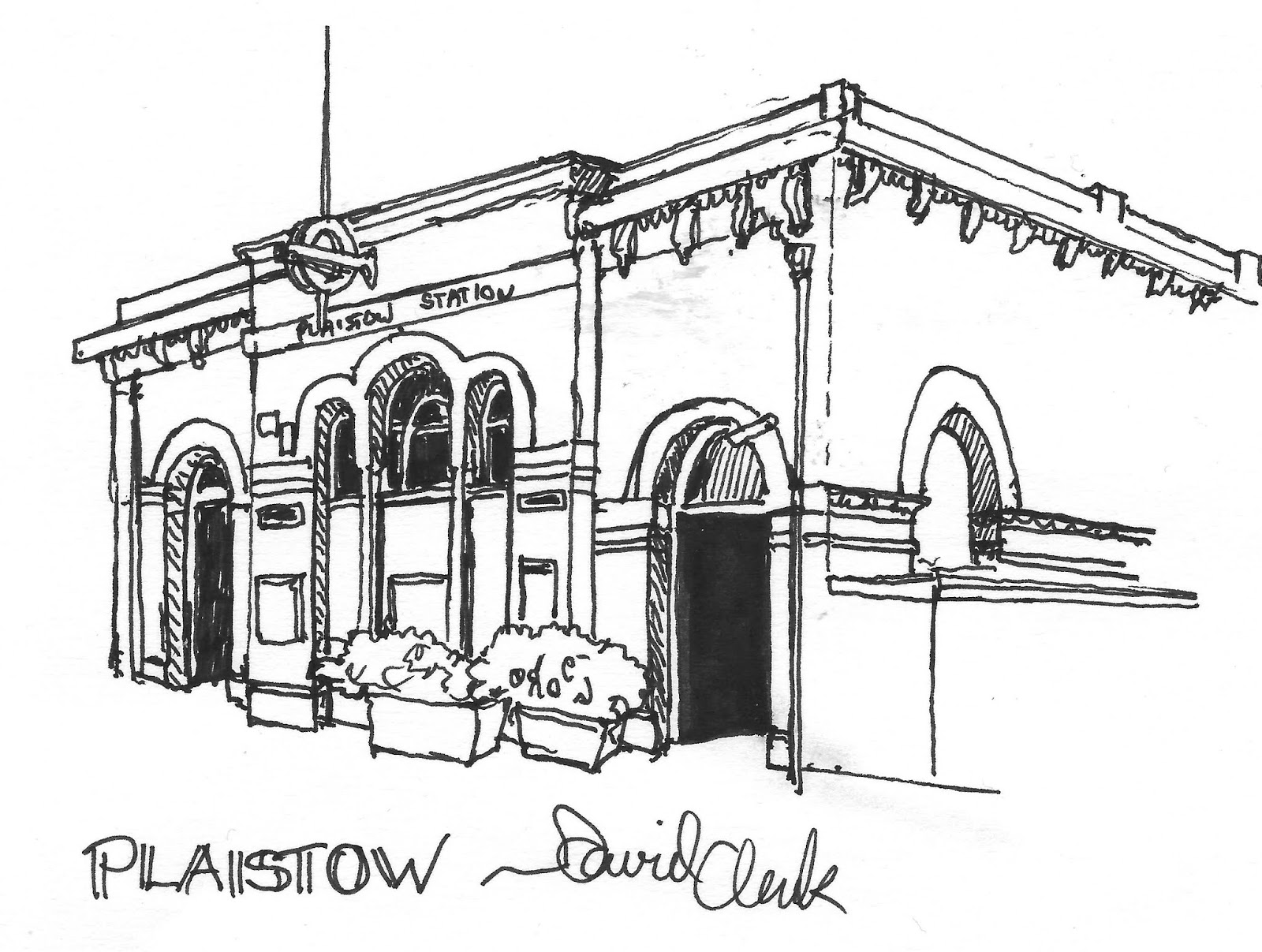
This is not an accusation you could make about Plaistow station. This is a big, impressive hunk of Edwardian architecture. I was surprised by the height of it – so far the older District Line stations have consisted of just the one fairly level floor at street level. Plaistow is far more imposing than the usual, and the ornamental brick arches and lines, and the cornices, prevent impressive from becoming oppressive. I also like the ornamental flower beds outside. I don’t really know what I was expecting on this eastward stretch of the line, but I suppose I was expecting a urn of stations like Bow Road, or maybe 1970s replacements. 

It was all change again for the station at Upton Park. Although not that very much, since it was constructed at the same time as Plaistow had been. This is a different slice of Edwardiana, though. It’s shorter yet longer, with its roofline boasting a pleasingly symmetrical set of gables. In a way these remind me of parts of the Hanwell and West Ealing sections of the Uxbridge Road in Ealing while I was growing up. So I’m told the station name has, at times, been used to indicate someone who is not quite the full shilling, as my Nan used to say – Upton Park, as in two stops short of Barking (mad). I was very tempted at this point to stop for a small celebration since this was actually the 100th station I’ve visited since I’ve started the challenge. I’d already sketched more than a third of all the current stations on the London Underground, and I hadn’t even realised it.  

Mind you, I mentally pulled myself up as I realised that this still left me 170 stations to go. This soon became 169 though. Station 101, East Ham was surely built and designed at the same time and by the same architect as station 100, Upton Park, since, to my admittedly untrained eye, it appeared extremely similar. Not that I was complaining. This combination of red brick and yellow London bricks is something I find extremely familiar from my childhood, and it speaks to me of my primary school in Hanwell in particular. I haven’t mentioned this earlier, but since Aldgate East we’ve been sharing with the Hammersmith and City Line. That’s a grand total of 11 stations, which is 11 fewer stations we have to do when we come to that line, which can’t be bad.  

The end of the line for the Hammersmith and City is the next station I visited on this District Line trip, Barking. Barking looks important, as befits a station which is the end of one Underground Line, and an interchange with both the London Overground and national rail. Important, yes, but not exactly attractive, with its uptilted apron overhanging the entrance, dating back to the early 1960s. The famous Nicholas Pevsner rather liked it and called it one of the very best of modern stations. I’m not entirely sure that, from this distance, almost 60 years later, I totally agree with him. It’s certainly not ugly, but calling it one of the best stations from the 50s and 60s isn’t necessarily that much of a compliment considering the poor nature of the competition. 

It’s the District Line and nothing but the District Line from here until we reach the end of the line at Upminster. The next station, Upney, was a little bit of a disappointment. At first glance as I left the building I wondered if it was another lacklustre 50s/60s creation. A few more minutes looking convinced me that this actually was more likely to date back to the 30s, the roofline above the station sign being a bit of a clincher, along with the dark brown brickwork. Subsequent research showed that I was right about that. It’s not ugly, but when you compare it with the stations Holden and contemporaries were designing for the Piccadilly line at about the same time, it seems to be a very lacklustre effort.  

I wasn’t able to discover for certain who was the architect of Upney, but bearing in mind the similarity of the next station, Becontree, I wouldn’t be surprised if it was designed by the same architect, William Henry Hamlyn, who was also the chief architect for the London, Midland and Scottish Railway. Despite their similarity, I rather liked Becontree a little more than Upney. Maybe this was just because the sun had come out briefly as I emerged from the station, and maybe it was because I stopped for a mini pork pie, which usually guarantees an improvement in my mood. 9 stations done, and only 6 more to go, I was quite a happy bunny.

 Dagenham Heathway was built at the same time as the previous two stations, it was a bit different, and if anything this little station is, I’m afraid, rather more nondescript. This might well be because when it originally opened it was on the LMS – London, Midland and Scottish Railway, which was one of the big four railways from the late 20s until nationalisation of the railways in the late 40s. Research says that the station buildings were renovated during the noughties, but it’s difficult to imagine that much of this can have involved the exterior, since it’s so bland and featureless. It’s a classic example of a whythe’ell station, as in whythe’ell is ‘e taking a photo of that station. I haven’t actually heard anyone saying this, but I’ve had a few looks which were just as eloquent as the actual words. As a rule, nobody looks askance at anyone brandishing a camera at anything in Central London, but when you get to the outlying areas, unless the station is an obviously striking building it’s not uncommon for you to get funny looks. I mean, why one Earth would anyone ever want to photograph a station like Ickenham, for example, a prime example of a whythe’ell if ever I saw one.
Although

I have to admit that when I was coming towards the end of the Piccadilly Line, when I got within half a dozen stations of Cockfosters I was beginning to feel a bit of tube fatigue, that is, a nagging desire to rush through to the end of the line and just get it over with. In retrospect, it was only for the last 4 Piccadilly sections, after I’d finished walking between Turnpike Lane and Bounds Green. Well, tube fatigue really started to strike as we approached Dagenham East. This was maybe a little unfair to the station itself, considering that it’s pretty similar to Upney and Becontree. But that just exacerbated the feeling, I suppose. Familiarity breeds contempt, and déjà vu was setting in quite badly, with the thought that there were still 4 stations to go, and for all I knew they might be just more of the same. There was plenty of daylight time left, so the only thing that could possibly stop me from finishing the District Line on this trip was a case of the soddits.

Thankfully, Elm Park was just different enough to keep me interested. In some ways the station reminded me a little bit of Boston Manor, which is one of my sentimental favourites, only without that station’s distinctive tower. The look is distinctly art deco, and the station was opened in 1935. It scores over the previous few for me because of the semi circular ends of the apron extending out from the flat roof. I think it’s this, and the later safety railings which particularly remind me of Boston Manor.


The day clouded over somewhat as I returned to the platform to take the next train to Hornchurch. This station was, I’m afraid, an almost soddit-inducing Upney identikit, although it does bost the saving grace of not having the window grilles on the left of the entrance covered up, as they are on the previous stations of this sort. Looking at these highly similar District line stations just makes my admiration for Charles Holden’s work all the greater, since although many of them have obvious similarities, they are all at least subtly different. Well, all of the ones I’ve visited so far. Atleast, by this stage there were only two stations left, and there was no way that I was going to cut this trip short now, which would only mean I’d have to trek out all this way again just for two stations.

Upminster Bridge, penultimate station on the District line, is not exactly a pretty sight. However it is, thankfully, an interesting one. Like the previous few stations, this was originally built and operated by the LMS, which may be the reason for the almost identical design of some of them. However, this is different. For one thing, it has a large structure rising up behind the entrance, in the way that many Charles Holden stations have ticket halls which rise behind the entrance. Mind you, there the similarity ends. This one is blocky, and could desperately do with some glazed screens. Still, at least it’s different from a lot of what we’ve seen on this trip and so at least has novelty value. I would imagine that maybe the station, with the façade having the station entrance balanced by the two shop buildings, this maybe looks quite appealing when the sun shines. When the clouds are threatening a soaking though, as they were when I visited, the place looks miserable, and rather unloved.

Upminster came as a complete surprise. It looks as I’d expect a late Victorian national railway station in a fairly prosperous market town would look. Yet research tells me that the entrance and ticket hall at least were another LMS building opened in 1932. Maybe this building incorporated parts of, or added to the Victorian station from 1885 – my rather sketchy research source wasn’t very specific. I could tell you that I allowed myself a certain amount of satisfaction that I’d now completed all of the stations on both Piccadilly and District Lines, the two lines with the most stations, but in all honesty I was exhausted, and didn’t even want to think about stations until I left the next train at Hammersmith on the way back.  

----------------------------------------------------------

A couple of days later, though, I did start to reflect on what I’d done, and what I had left to do. The District line has 60 stations, and the Piccadilly Line 53. Granted, a number of them are on both so were only sketched once, but even so I’d made significant inroads to the challenge. My plan was to work my way through the lines with the most stations first. Logically this suggested that I should tackle the Northern Line next, since it had the next highest number of stations with 50. However, the fact was that the Central line only had one fewer station with 49. With the Northern Line I knew that south of the Thames at least, we had a good run of interesting stations. With the Central line, I couldn’t be at all certain. So it might be a good thing to tackle the Central now, while I still had heart for the challenge, and while tube fatigue wasn’t setting in until I got to the end of each line. Also, the Central was one of my ‘home’ lines, with the shorter Western arm ending at Ealing Broadway. Good enough, Central Line it would be.

Catching Up . . .

Been a while, hasn't it?  Don't worry, I haven't given up sketching. No, I just haven't got round to posting anything. Now, ...