Please note that all of these London Underground sketching trips were made before any corona virus restrictions were put into place.
On paper,
this task shouldn’t be so difficult. There’s seven stations between Goldhawk
Road and Royal Oak, and once I’ve bagged them then the H and C line is done.
However, the Victoria Line is an issue. There’s 6 stations between Walthamstow
Central and Highbury and Islington, only one of which, Finsbury Park, I’ve
already bagged. However there’s another 4 stations between Pimlico and Brixton,
only one of which, Stockwell, I’ve already bagged. So the most time economical
solution to this trip involves working the Victoria to Kings Cross, bagging
stations along the way. From Kings Cross I take the H and C to Royal Oak, and
bag stations from Royal Oak to Latimer Road. From there I plan to walk to
Shepherd’s Bush Market station, bagging stations in between. Back on the train
to bag Goldhawk Road, and then walk to Hammersmith District and Piccadilly
station. By District train to Victoria, and from there to Brixton, bagging the
last stations on the way. It sounds contrived, but believe it or not it is the
most elegant solution I’ve come up with to complete the one day, two lines
nature of today’s trip.
Now, to me,
the name Walthamstow – which is Old English for Waltham Abbey, believe it or
not – conjures up the looming bulk of Walthamstow Stadium, with its neon
greyhound sign so clearly visible from the North Circular. It’s been gone for
more than a decade now. I never actually visited the stadium, but I did spend a
few memorable evenings ‘down Catford Dogs’ when I was a student living in
Lewisham. When it comes to dog racing, I have maintained a proud 100% record –
never made a penny out of it.

Walthamstow Central
Station pulls off an unusual trick. It looks like a boring bus station, while
the bus station looks like a modern interpretation of an art deco tube
station.Following up from a photo on Wikipedia I take a walk around, and find
the old building on the London Bound side. It’s surely Victorian or Edwardian
at the latest, and quite similar to a lot of buildings I’ve sketched from the
northern arms of the Bakerloo and Metropolitan. The original station built here
opened in about 1870 – this may possibly be it. Like the bus station, this one
also has tube signs on it, as well as mainline rail. So I set off on this final
trip in a happy mood, knowing that whatever else the Victoria may present us
with it has at least one striking station, even if we can’t count the bus
station. Part of it.

Wikipedia tellingly observes that the Victoria Line stations built in
the 60s had little money available to be spent on them, and my first thought
about Blackhorse Road is that this
is just what it looks like. Even donning my rose tinted spectacles to look at
it more closely, it’s never going to win a place among my 135 best looking
stations. But for all that the attempt to give this building some flavour or
character is a half-assed one, the fact is that it is an attempt. The different
levels of flat roof may give the appearance of having been designed by a child
let loose with a lego set, but at least there’s something to divert the eye
away from the concrete. While I’m in such a forgiving mood as well, I might as
well note that I liked the tiles on the platform which feature a stylised black
horse in a white cameo on a blue background. It’s probably something that
regular users pay little attention to, but you just don’t get this sort of
thing in most European metro stations that I’ve ever visited. The station,
though, is the poor cousin of the Victoria Line. According to my research no
Victoria Line station has fewer users.

A decade after I moved away from London, my Mum moved from Ealing to
Tottenham. Well, to be fair, her husband, my step father lived there, so it
wasn’t an unreasonable thing. Until they moved to Worthing in 2011 I visited
them many times, and used the Tube, yet the closest station was actually Wood
Green. So I’ve never previously visited Tottenham Hale, despite knowing
the general area probably a bit better than I know many parts of London. What
can I say? Well, it’s one of those stations I shouldn’t be too harsh about
because it’s being remodelled and upgraded. At the moment, well, when I visited
there really wasn’t much to see, which you can probably see from the sketch.
All I can tell you is that if it looks like the artists impressions on the TfL
website when it’s finished, then it will be a lot better and more attractive
than the building it replaces. Don’t hold your breath, though, for in the
artists impression the whole building seems to in rural Scandinavia, rather
than the aesthetically challenged built up area of Tottenham Hale. To be
honest, since I’ve know the area, Tottenham Hale has been crying out for a
little bit of relief from crap buildings.

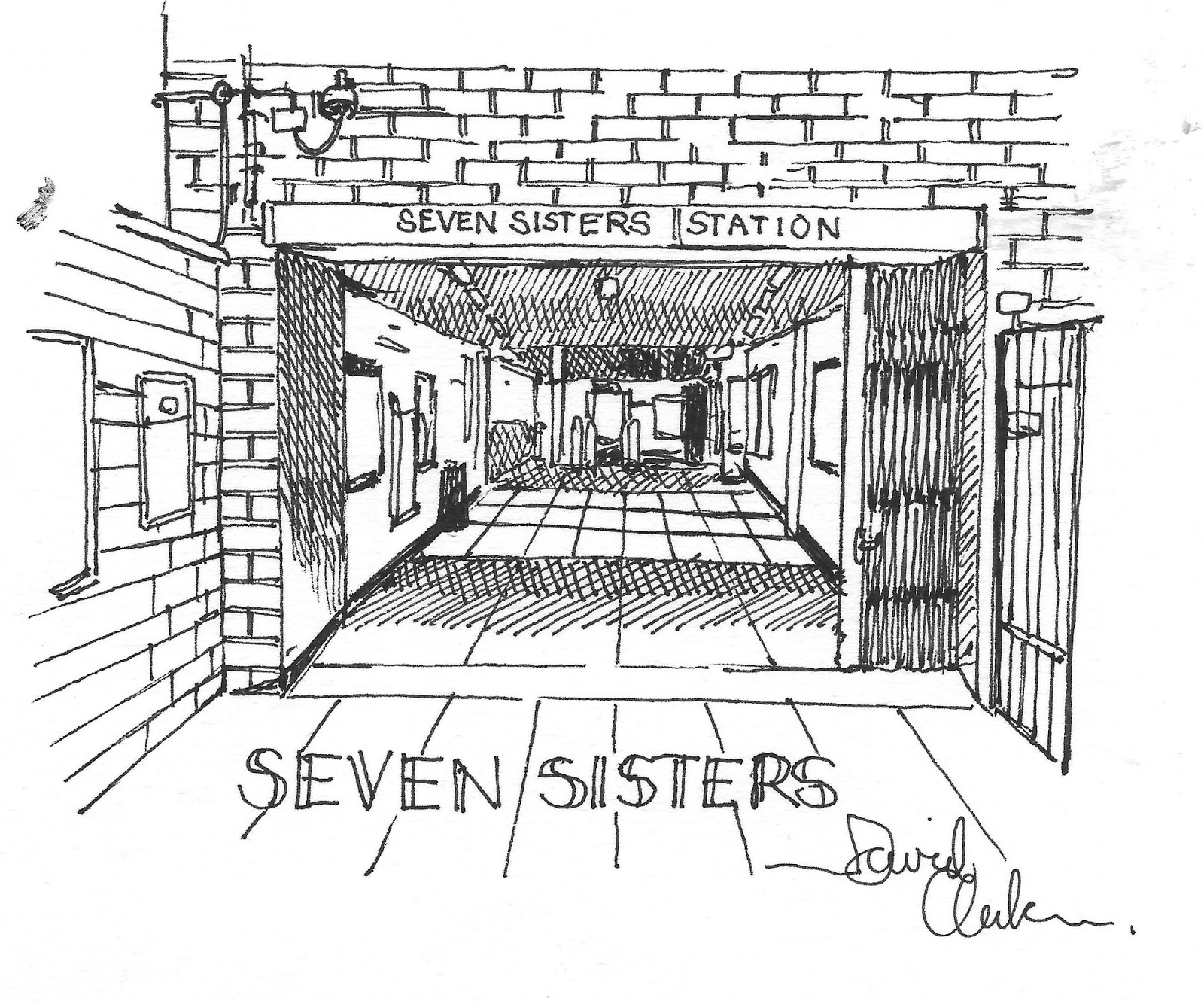
The sketch I made of Seven
Sisters station isn’t really the station buildings, since it doesn’t really
have any of those. The two exits just kind of vomit you out onto the street,
and they’re little more than holes in walls, a la South Kenton. Near one of the
exits, though is an empty retail outlet, presumably owned by TfL, since in 2017
they commissioned a pair of artists to hand craft the ceramic tiles which now
cover it. Close up I like the marbled tiles very much. I’m sorry, but try to
appreciate them as I might, the yellow tiles with random dark blue splodges
don’t appeal to me at all. But I like
the idea. I like the sentiments behind the idea, that this was a way to enrich
passengers’ journeys by doing this to a building which is part of their daily
commute – although I can’t help thinking that passengers might say cheaper
fares and a better service might do this rather more effectively. Cynicism –
I’m sorry. Let’s lighten the mood a little with a wiki fact. The section
between Seven Sisters and Finsbury Park is the longest between any two adjacent
stations in deep level tunnels on the network. Woo hoo!

A really lovely section of the original station building at Highbury and Islington, next station after
Finsbury Park, which looks contemporary with Leslie Green’s work, still stands.
Wikipedia confirms it was opened in 1904, although it was part of the North
London Railway, which was not to be part of the Underground network. Sadly,
though, the station we actually emerge from is the original Victoria Line
station from 1968. It isn’t ugly, it’s far too nothingy for that. Alright, to
be fair the original station was highly damaged by wartime bombing, and as
Wikipedia suggests, the line had to be built on the cheap, because they
couldn’t afford to do it on the expensive. Highbury and Islington were of
course another music hall duo, although despite the geographical connection
they didn’t include a certain song not entirely unconnected with a North London
football club in their repertoire.
All of which
drollery completes the northern section of the Victoria line for me. From here
I alight at Kings Cross, and take the Hammersmith and City Line for another
trip along the oldest part of the network.
John Fowler,
original Chief engineer of the Metropolitan Railway, was nothing if not
ingenious. His original thoughts about the smoke produced by the locomotives
were that since they were only being required to haul short distances, they
could get away without using much coal to heat the boilers to make the steam.
He designed an engine whose boilers would be brought to temperature through a
normal firebox, but whose boiler was full of heat retaining firebricks. Steam
was to be captured and condensed and the water thus used again. It’s a
potentially brilliant solution which suffered from one main drawback. It didn’t
really work. The condensing system leaked, the boiler ran dry and came close to
exploding. Fowler’s prototype, nicknamed his ‘ghost’ years later, was ruled a
failure before the railway ever opened, and was never used by the railway again
after the trials. Let’s not be too harsh on Fowler. When it comes to innovative
engineering the line between success and failure could be a very narrow one,
and Fowler himself is one of the engineers we have to thank for one of the
great wonders of the industrial age, the Forth Bridge. (NB – as Billy Connolly
once pointed out, the bridge with the roadway is the Forth Road Bridge, the
bridge with the railway is The Bridge.)
We now zip through 5 stops, most of which are beginning to feel like
old friends. Finally I alight at
Royal Oak, incidentally the last
station I visit which is named after a pub. Now, although I have never
previously walked upon the station’s platforms, I have often observed them,
since the mainline into Paddington passes underneath the same bridge on which
the station is situated. In my early days of living in Wales, I would sometimes
come back to London on the train. These were the days when I still qualified
for a Young Person’s Railcard. If I may be permitted to get on my soap box for
a moment or two, one of the great scandals of this country is the way that
people are priced out of using public transport. What first brought it home to
me was the first trip back to London after I passed my driving test in 1991. My
Father in Law had gifted us his Ford Fiesta when he bought a new Escort, and I
made that first trip to London with my wife, and the two children who were the
extent of my family back then. It cost us about a tank and half of petrol – and
I could fill that Fiesta for £10 back in 1991. Even with a family railcard,
travelling at whichever ungodly hour would entitle us to the cheapest fair,
we’d still have been paying several times that to use the train. Sadly the
situation hasn’t improved the slightest since. In fact, the last time that I
took a train to London was in the mid noughties to appear on a quiz show, and
the only reason I did it was because the Beeb were footing the bill.
The exterior
of Royal Oak is a nice old building, which must be a centenarian, but the
details are difficult to photograph or sketch because of being obscured by the
superstructure of the railway bridge. This gives it something of the feel of an
old remnant from times gone by that everyone has forgotten about, and I quite
like that.

To show you
how out of touch I am, I’ll let you know that I thought that mainline services
into Paddington still stopped at Westbourne
Park. No, I’m only about 30 years too late for the last one to stop there,
apparently. I used to take the local British Rail trains – sludgepots as we far
from
affectionately called them – from Ealing Broadway to Paddington for a
bit of trainspotting, and Westbourne Park was always the last stop. Now it’s
Acton Mainline. As for Westbourne Park, I believe the station building dates
from 1871, and while I’m no expert I’d say that the style is more Great Western
than Metropolitan Railway. It’s really rather grand, although the boarded up
windows by the main entrance make it look slightly sad, like a dowager duchess
who’s fallen on hard times. Wikipedia tells of industrial archaeology around
the station which has revealed evidence of some of Brunel’s original Great
Western Railway buildings in the area, but there’s nothing obvious revealed by
my quick glance around outside. Time’s getting on.

Ladbroke Grove is a funny little place. I’ll admit that I
couldn’t find out that much about it from Wikipedia. Yes, okay, it was
originally named Notting Hill, but was renamed to avoid confusion with another
station – Hammersmith, Paddington and Edgware Road take note, please. Renaming a station to avoid confusion, even on the London Underground it can be done! I mean,
I’m guessing that the brickwork around the entrance way has some age to it.
However the grey glazed section above it is more modern, and less interesting.
Then there’s that canopy above the entrance – giving it that pointed gable is
just a little half hearted in my opinion. Still, let’s stop moaning shall we,
it’s perfectly inoffensive, which is at least something.

Latimer Road is where I’m going to begin my last walked
section. My original thought was to get back on the train at Shepherd’s Bush
Market, but considering that Goldhawk Road is at the other end of the market it
didn’t make sense, and so I decided to bite the bullet and go the whole hog,
walking past all my remaining H and C line stations, to the District Line at
Hammersmith. Latimer Road, then, reminds me a little bit of Parson’s Green.
There’s certainly a bit of age to it, but it’s swallowed by the viaduct that it’s
built into. You can’t help noticing the fact that the Grenfell Tower is behind
the station. I have nothing I can say about this other than to express my
sincere sympathy for the victims before moving on towards Wood Lane.

If you're of a similar age to myself, then the street name Wood Lane is indelibly linked in your mind with BBC
Television Centre. Before the BBC shut up shop and moved on, I had the
experience of working in TVC, as we called it then, being an audience member,
and appearing on a live show, although not at the same time. Wood Lane today,
though, is almost all about the Westfield Centre. At the time of writing this,
the Westfield is the largest shopping centre in Europe. Now, I may well be in a
minority in my view, but my view is that shopping centres are a necessary evil,
while shopping centres this size veer more towards the unnecessary. I’m sorry,
but to me shopping is
not a source of pleasure, either as a participant or a spectator. Wood Lane
station itself, then, is a modern, stainless steel and glass confection. In
layout the exterior is a little reminiscent of Farringdon, I suppose. It does
lack the imagination of the best of the Jubilee line extension stations which
we saw on our last trip, and that’s a shame considering the opportunity that
was there. I don’t know if this is a coincidence but this station was designed
by Ian Ritchie Architects, who designed probably the least interesting Jubilee
extension station at Bermondsey. I can’t help wondering why this is, since
their work in Europe often ticks all my boxes. Mind you, I don’t know what
stipulations were made by TfL which had to be adhered to.
I decide not to pop into the Westfield, but continue walking to
Shepherd’s Bush Market station. Mind
you, if I were offered to choose an hour in the Westfield or half an hour
sitting with a pencil in my eye I’d probably have opted for my 30 minutes with a
Staedtler HB so that’s not saying a great deal. Shepherd’s Bush Market is what
seems to be a solitary example of TfL renaming a station which has the
confusing same name as a totally different station. Prior to 2008, although not
connected to the Central Line station of the same name, this was called just
Shepherd’s Bush. Of the two Shepherd’s Bush stations, this has the oldest
building, but basically the entrance is just a covered over staircase leading
up to the platforms on the viaduct. It's
something of a nostalgic pleasure to walk through Shepherd’s Bush Market. It
was here that I bought my second hand copy of Frank Herbert’s “Dune” from a
bookstall when I was 16, and a fine 50p’s worth that proved to be. I don’t
waste time looking for the stall, but power on, with the scent of victory in my
nostrils, knowing that my last unbagged H and C line station is just outside the
opposite end of the market.

Goldhawk Road, from which the station takes its name, played a small
cameo role in my family’s history, when it was where my great grandparents were
married in 1905. There’s a rather dog eaten family photo which shows the pair
of them, my great grandmother resplendent in full Edwardian finery, even
including a parasol – a little incongruous since it was the end of December
when they were married. My great grandfather, seated, wears a formal suit,
although rather incongruously he also has a flat cap on his head.
As for the
tube station, well it’s another one built into the side of the viaduct carrying
the railway overhead before its final descent into Hammersmith. The curved
canopy imbues it with a modicum of visual appeal, but there really isn’t that
much to work with, I’m afraid.
Back on the
train then, only allowing myself a small celebration for completing the
Hammersmith and City. Then I allow myself an even smaller one as I realise that
I’ve also completed the Circle Line too – all of its stations being shared with
other lines. All we have left to do is the southernmost section of the Victoria
Line.
As I walk between Hammersmith and City Hammersmith station, and
Piccadilly and District Hammersmith station, it seems like an awfully long time
ago that I last passed this way on my third Piccadilly Line trip. Purely in
terms of time it’s just been a few weeks, but in terms of experience it seems
far greater than that. I tell myself that with three stations still to go this is
no time to start reflecting on the whole experience. I concentrate on the route
I’m going to take – which is not a difficult one, since it just involves
changing from the District Line to the Victoria at Victoria. Now that sets me
off on a train of thought, and not the most pleasant one either. Bearing in
mind the other stations I visited at the start of the day, and other Victoria
Line stations I’ve visited in previous trips, I have to say that unless the
last three stations pull something pretty spectacular out of the bag, then the
Victoria Line will be the most likely winner of the award from the least
architecturally interesting line. And I don’t actually want to be horrible
about the Victoria. Bearing in mind the state of the country at the time, it’s something
of a miracle that a new line was built in the mid to late 60s in the first
place, and bearing in mind the quick , cheap and crap building ethic of the
time, the fact that it hasn’t all fallen to bits since is even more of a
miracle.

Well, Pimlico
does nothing to raise the standards, I’m afraid. It’s just a hole in the wall
of a contemporary office or residential block. I don’t really know much more to
say about it. Pimlico (noun - generic) Artificial flavouring used which,
when applied to foodstuffs, makes them taste unlike whatever flavour they are
supposed to simulate. UK crisp manufacturers are believed to currently use as
many as fifty different varieties of Pimlico. Actually, the name Pimlico is
redolent of the wonderful Ealing Comedy film “Passport to Pimlico”, which was
mostly filmed across the river in Lambeth. As an Ealing boy myself, I feel very
protective of the output of our eponymous studios. To a modern audience I wouldn't exactly describe them as laugh a minute, but they're totally engaging, and give a real flavour of what life was like in parts of Britain, and in particular, London in which my parents grew up. Coming back to Pimlico station, it is the handiest station for the original Tate Gallery, now called Tate Britain to distinguish it from all of the sequels which have spring up since.
Across the
river for the last time in our challenge, we now reach the station after which
all stations
on the Moscow metro are partly named,
Vauxhall. Like
Walthamstow Central at the other end of the line, Vauxhall tube station is just
one part of a public transport interchange, and the bus station is particularly
impressive. The ticket hall of the tube is Underground, but as you can see, at
least one of the entrances is through a really interesting slice of modern
architecture. Things sure have changed around Vauxhall Cross since it Used to
cycle past on my way home from University. Which leads me to make an
observation, while I think about it. I stayed in Lewisham, while attending
Goldsmith’s College in New Cross. Even leaving out the section from Lewisham to
the college, if I came straight home from the college for a weekend, the
fastest way on public transport was to walk to New Cross or New Cross Gate
station, take British Rail to Charing Cross, which was much quicker than taking
what was then the East London Line. From there the tube to Hammersmith, where
I’d change to the Piccadilly, and from there to Northfields, and then walk the
rest of the way home. The fastest I ever did the journey was about 45 minutes.
By the end of my first year, once I was fairly fit, on a Friday lunchtime I
could do the same journey on my bike in 35 minutes. Mind you I did get knocked
off twice, which didn’t tend to happen on the tube.
These times,
mind you, pale into insignificance when compared with my first journey through
Brixton. This would have been in the early 70s, when my mum and dad took me and
my two brothers on a day out to Crystal Palace Park in Sydenham. This was a
journey accomplished through the use of Red Bus Rover tickets – remember them?
Didn’t think so, and at a conservative estimate it took about 3 weeks. Or
that’s how I remember it.

I have to be honest, I was very pleasantly surprised when I emerged
from Brixton station. To those of us of a certain age, I guess that the
name Brixton carries some negative associations. There’s Brixton prison, for
example. Then there’s the riots of the early 80s. But I have to say, this
station really surprised me when I read that it was opened in 1971. Then I read
that it was redesigned in the noughties, which made a lot more sense. This is a
bright and fairly impressive modern station. I like the huge glazed frontage,
prominently featuring the roundel – a nod to Charles Holden’s work on the South
London stations of the Northern Line, albeit possibly a subconscious one. It
ends the Victoria Line for us on a surprisingly upbeat note, and indeed that’s
the challenge. Done.
------------------------------------------------------------------------