Friday, 3 April 2020

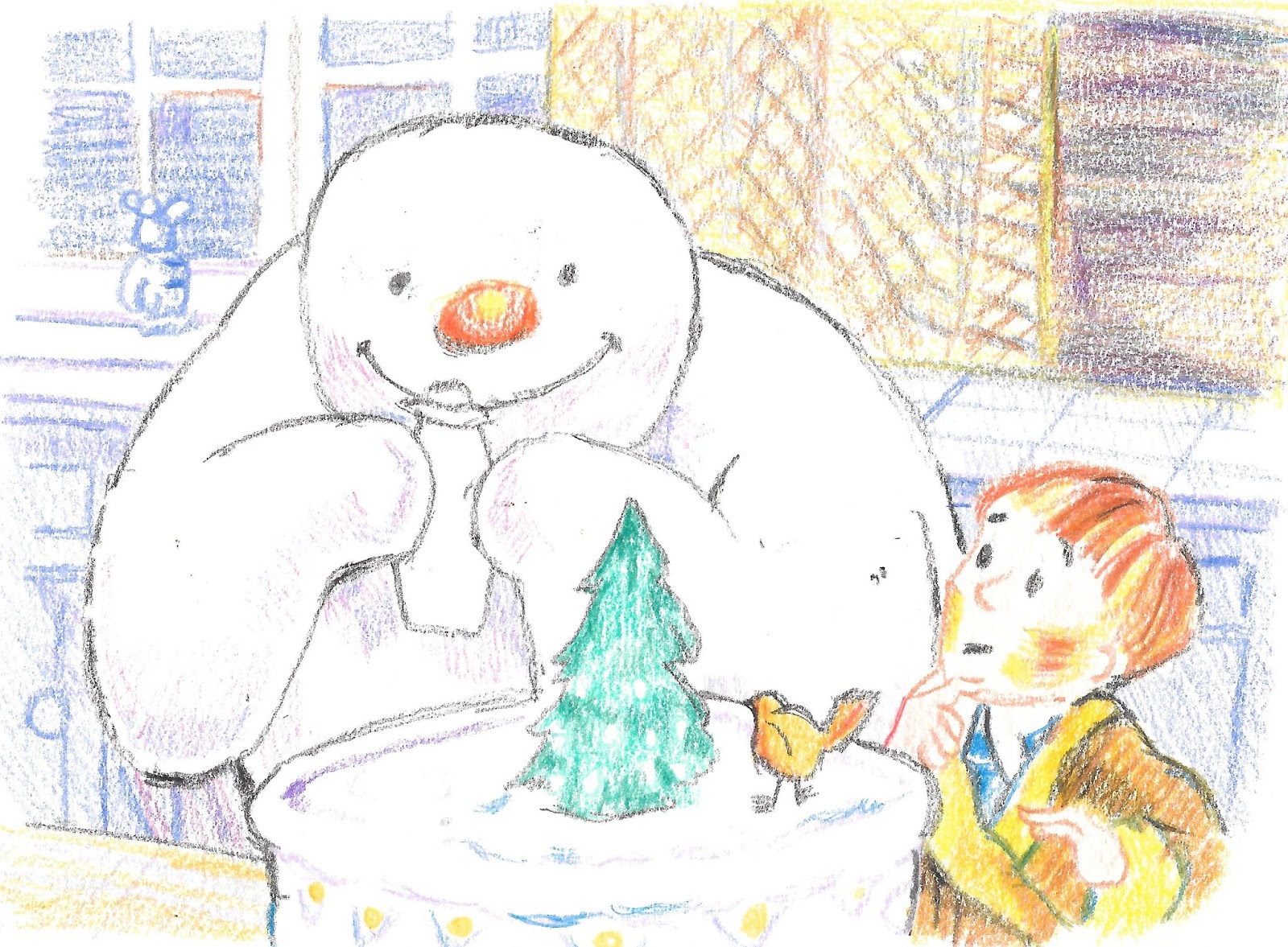
British Illustrators 14: Raymond Briggs and The Snowman


If we’re looking for a challenger to Beatrix Potter’s crown as top British writer/illustrator, then we probably don’t need to look any further than Raymond Briggs. In fact, you could make a case that Raymond Briggs is more versatile than Beatrix Potter was, since he has proven he can write equally well for children and adults. Twice winner of the Kate Greenaway medal, he’s unlucky not to have won it a third time yet. Mind you, nobody else has won it three times either.

I thoroughly enjoyed making my copy from “The Snowman”. It was interesting to read that Raymond Briggs chose to use coloured pencils for the book because he wanted to do something quick, clean and fresh – his words. Personally, I found that as much as I enjoyed trying to imitate his style, it was by no means a quick process. Quiet a rewarding one, though. 
British Illustrators 13: Pete Sutherland and “The Tough of the Track”


Even growing up in the 70s as I did, there were still comic strips around which were hangovers from the golden age of the 40s, 50s and 60s. Sports stories were one mainstay of these – with the football based strip “Roy of the Rovers” being the most famous. I was never a fan of the adventures of the eponymous Roy Race, but I did really like a strip called “The Tough of the Track”, which chronicled the adventures of working class amateur athlete Alf Tupper. Alf Tupper was a sometime welder, sometime plumber, whose training methods consisted of not a lot more than a quick run around the block, and a diet of fish and chips. He was in a running battle with the ‘posh’ authorities in the Amateur Athletic Association, and the posh but inferior runners they selected to represent Great Britain ahead of indomitable Alf. The strip ran for about 40 years, all told, until the early 90s. It was drawn by many hands at different times, but is most closely associated with Peter Sutherland. Peter Sutherland joined the staff of D.C. Thompson in Dundee after serving in World War II, and he remained working at a prolific rate on a wide variety of strips until just before his death in 1977. He’s best remembered for “The Tough of the Track”, though.

Thursday, 2 April 2020

British Illustrators 12: Frank Hampson and Eagle Comic


If I’m talking about British illustrators whose work has graced the fiction I read as a kid, then I mustn’t ignore the field of comics.

The Eagle Comic, which was originally published in the UK from 1950 to 1969, was a little too early for me to catch it first time round. In fact, it was something my father read in its early years. However, old Eagle comic annual books were a staple item in dentists’ and doctors’ waiting rooms throughout the 70s , and this is how I came to fall under the spell of Frank Hampson.

The comic was actually founded by Marcus Morris, an Anglican priest, who collaborated with graphic artist Frank Hampson. The idea was to promote the Christian values of the Church of England, although I’d argue that proselytizing very much took a back seat to telling stories of action and adventure. The Eagle, which had expensive production values for that time in post war Britain was an instant success, and a lot of this was due to chief artist Hampson. I’ve copied a picture from one of his front covers featuring the Eagle’s most famous strip, Dan Dare, Pilot of the Future. If you read many of the stories now it might be difficult to grasp the excitement a boy of my father’s generation might have felt, but it’s not at all difficult when you look at Hampson’s artwork.

Tuesday, 31 March 2020

British Illustrators 11: Sir Quentin Blake


Sir Quentin is in his 80s now, and still going strong. He’s indelibly associated with the works of Roald Dahl – I picked an illustration from “Charlie and the Chocolate Factory”, the first Dahl novel I ever read. For me it’s difficult to think of Roald Dahl’s books without thinking of Quentin Blake’s illustrations – as writer and illustrator they were an absolutely perfect match. However, Sir Quentin’s portfolio is much wider and more varied than that. Sir Quentin was the first ever Children’s laureate in the UK, and a good choice for that honour too.


Like Ronald Searle and Peggy Fortnum, his style looks deceptively simple. Yet when you try to make a copy of one of his illustrations you start to realise just how clever and precise it actually is. No single pen stroke is wasted, and as a result all of his pictures crackle and sparkle with life and personality.

Monday, 30 March 2020

British Illustrators 10: Beatrix Potter


Any discussion of great British illustrators of children’s fiction in the 20th century can’t ignore the claims of Beatrix Potter as one of the finest. She was arguably the greatest writer illustrator. Beatrix Potter wrote some thirty books, starting with The Tale of Peter Rabbit. Now, I’ll be honest, while I loved “The Tailor of Gloucester” and “The Tale of Jeremy Fisher” when I was a kid, I really didn’t like some of the other stories very much. For example, I thought that “The Roly Poly Pudding” was very weird, and not a little disturbing for that matter. But I still think that Beatrix Potter’s illustrations were never less than engaging, and some of them are absolutely enchanting.

British Illustrators 9: Thomas Henry and Just William


Richmal Crompton was a teacher in south east London who took up writing seriously in the early 1920s after polio forced her to give up her teaching career. It was about this time she created her 11 year old anti hero William Brown, popularly known as Just William after the title of her first collection of stories about him. She continued to write stories about William for almost 50 years, although it’s said she became somewhat resentful of the stories’ popularity, as she really saw herself as a writer of adult fiction.


Maybe it was the fact that I was generally a very well behaved, studious kid myself which made the scruffy, anti-authority, anarchic William appeal to me so much. Maybe it was just because the stories were so funny and well written that I loved William. I think it’s quite possible that Thomas Henry’s illustrations had something to do with it as well. Thomas Henry, although barely remembered now, was already a prolific and successful magazine illustrator by the time he was commissioned to illustrate Just William, and the William books kept him gainfully employed until his death in 1962. I’m a little frustrated that I just haven’t quite captured William’s face correctly in this copied sketch. Not quite.

Sunday, 29 March 2020

British Illustrators 8: Peggy Fortnum ad Paddington Bear


If we’re discussing British children’s illustrators of the 20th century, we can’t really ignore Peggy Fortnum. Peggy Fortnum, who passed away in 2016, illustrated over 50 books, but she’s best known as the original illustrator of Michael Bond’s charming Paddington Bear books. The idea of anyone else having illustrated Paddington is about as outlandish as anyone other than E.H. Shepard having illustrated Winnie the Pooh.


Copying this picture was an interesting and surprisingly challenging experience. It looks simple, yet I found that every one of her lines was precisely placed, and imprecision on my part rendered the sketch far less effective than the original.

Catching Up . . .

Been a while, hasn't it?  Don't worry, I haven't given up sketching. No, I just haven't got round to posting anything. Now, ...